


Passionate about tropical gardens 
The Tropical Gardens network is INTO’s vibrant, cross-continental initiative which brings together INTO members from Sri Lanka, Thailand, India, Malaysia, the Maldives, St Helena and Zimbabwe in order to share their stories of their landscapes, challenges and aspirations. From desert parks to rainforest sanctuaries, each site is unique – but all are united by a shared commitment to sustainability, cultural heritage, community engagement and the preservation of tropical biodiversity. The idea was sparked by Soham Kacker, plant ecologist and horticulturist who is the Curator of Living Collections at the Lunuganga Trust, at the gardens of Geoffrey Bawa Trust in Sri Lanka https://geoffreybawa.com. Members expressed a strong desire to learn from one another, share best practices and explore how gardens can be tools for education, healing and cultural revival.
The NTZ was very excited to receive the good news from Mr Alexander Bishop that a INTO TAP Award had been granted on behalf of the newly formed network. The award was an opportunity for a bilateral exchange between members prioritising those that live relatively close together in the first instance to facilitate knowledge exchange. The award allowed travel funds for Mrs Helena Bennett, Director and Mrs Matrina Peters, Environmental Scientist of the St Helena National Trust.
St Helena is a small, remote volcanic island consisting of 47-square-miles, situated in the South Atlantic Ocean, roughly 1,950 km west of Angola. It is famous as the place of Napoleon Bonaparte’s exile and death. The capital is called Jamestown and it has a population of approx. 520,000 people. The climate of Saint Helena is tropical, marine and mild, tempered by the Benguela Current and trade winds that blow almost continuously.
On the 11th June 2026 members of the NTZ Executive Council were very excited to welcome Helena and Martina to Zimbabwe and were fascinated to hear about the island and all the work that they undertake there. St Helena’s isolation and its rugged terrain have been the saviour of a few fragments of the original natural habitats and a wealth of their constituent species. The Trust carries out a range of conservation projects looking after the islands unique terrestrial, marine, built and cultural heritage. The Trust plays a large role in raising the education and awareness of the island’s heritage in local and international communities.
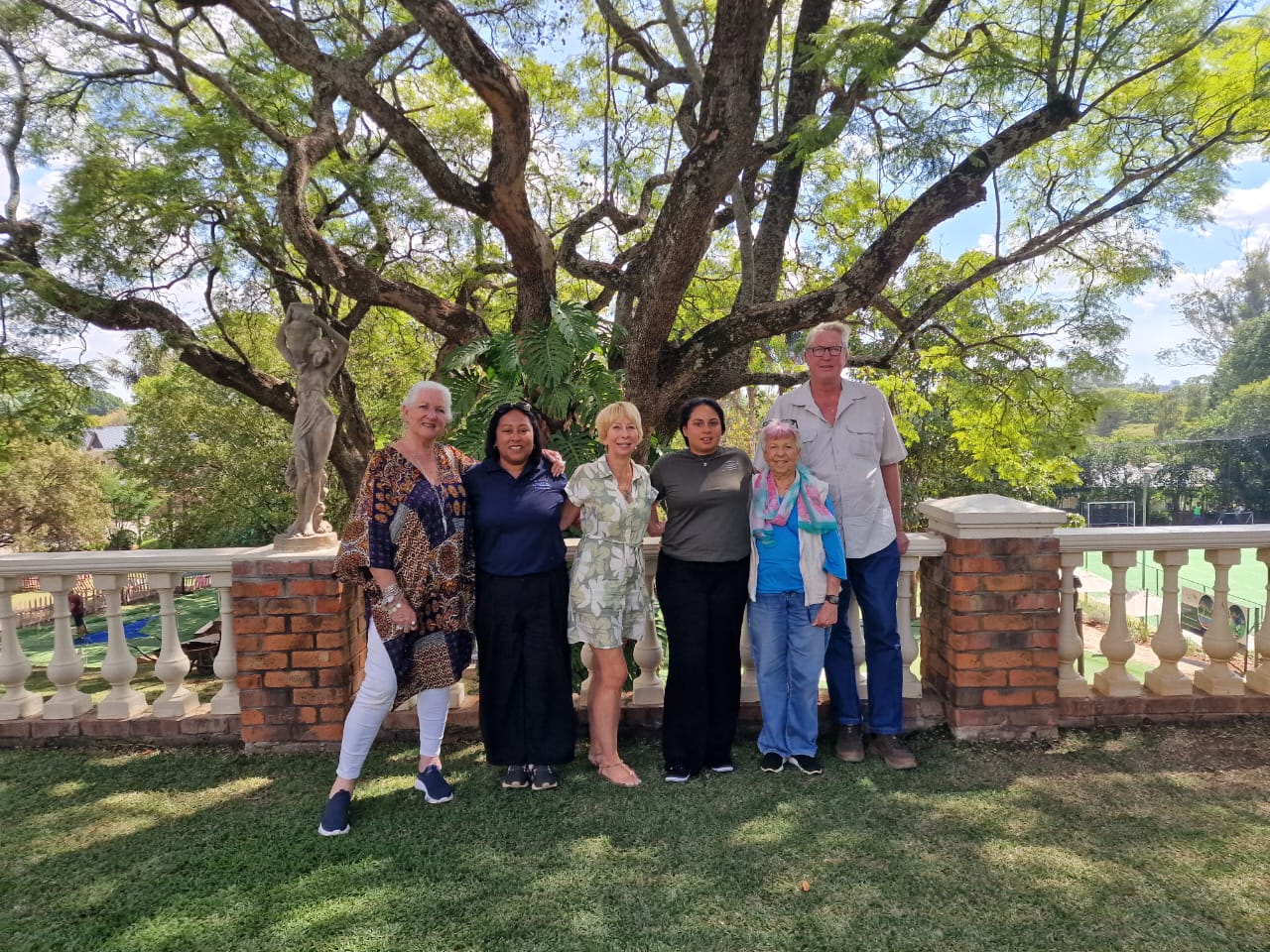
Left to right: Lin Goncalves, Helena Bennett, Sharon Waterworth, Martina Peters, Fira Bache and David Cozens
Saint Helena’s biodiversity includes marine vertebrates, invertebrates (freshwater and terrestrial and marine) fungi, non-vascular plants, seaweeds and other biological groups. The island has long been known for its high proportion of endemic birds and vasualr plants. The highland areas contain most of the 400 endemic species recognised to date. Much of the island has been identified by Bird Life International (BLI) as being important for bird conservation especially the endemic Saint Helena Plover and for sea birds breeding on the offshore islets and stacks in the north-east and the south west.
During their 5-day stay in Zimbabwe our lovely colleagues visited the following 3 NTZ properties in the Eastern Highlands area:
La Rochelle Country House
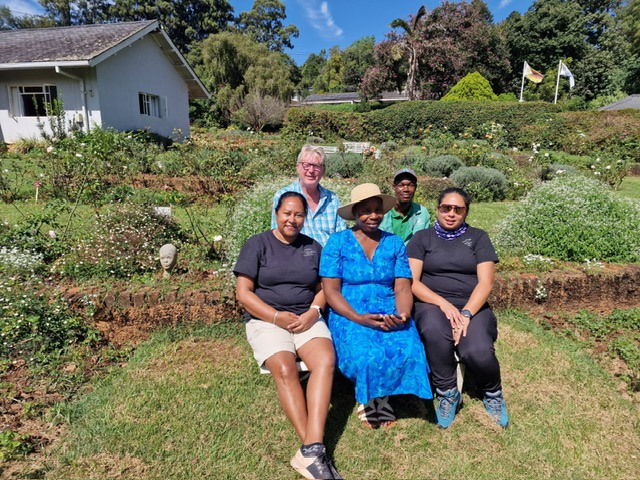
L to R: Back row: David and Nhau Tinga Front row: Helena, Diana Chasauka and Martina
Helena and Martina spent time walking and working around the estate with Diana and Nhau, the husband and wife team who have been caring for the La Rochelle heritage orchid collection and the gardens for 32 years. La Rochelle Country House estate comprises of 226 acres and has a large unique botanical garden covering 20 acres of land, established with the professional help of the UK Horticulturist John Henry Mitchell, with exotic plants and trees gathered from all over the world. There are exotic trees in the arboretum as well as palms, cycads, azaleas and other flowering shrubs. Their particular interest was the orchid house filled with exotic, rare and indigenous heritage orchids.
Murawha’s Hill
L to R: David, Lloyd Chidondo, Helena and Martina and Eng. Jackson Njunga
Helen and Martina were warmly welcomed by Eng. Jackson Njunga, the property Manager and Executive Council member of Murawah’s Hill a large granite hill, 153 acres in extent. Together they toured around the site accompanied by Lloyd the caretaker who lives on the site. Murawha’s Hill forms the backdrop to the western side of the City of Mutare. Named after a local Headman Madekurahwa under Chief Mutasa who lived at the foot of the hill from around the second half of the 19th century. The Hill was used as a shelter and look-out point against Chief Gungunyana and his raiding parties. It is a place of cultural importance, a naturalist’s paradise and is of great archaeological value. Traditionally it was protected in the past as a place of spirits.
The Hill has a unique combination of cultural heritage and indigenous flora and fauna given its location visa-vis the prevailing moisture-bearing winds. Over the years an extraordinary number list of trees and birds have been recorded. These comprise Eastern Highlands and Middleveld species, as well as broad range of vines, fungi, mosses and ferns. The ancient indigenous rainforest and rocky outcrops bought special delight.
Worlds View
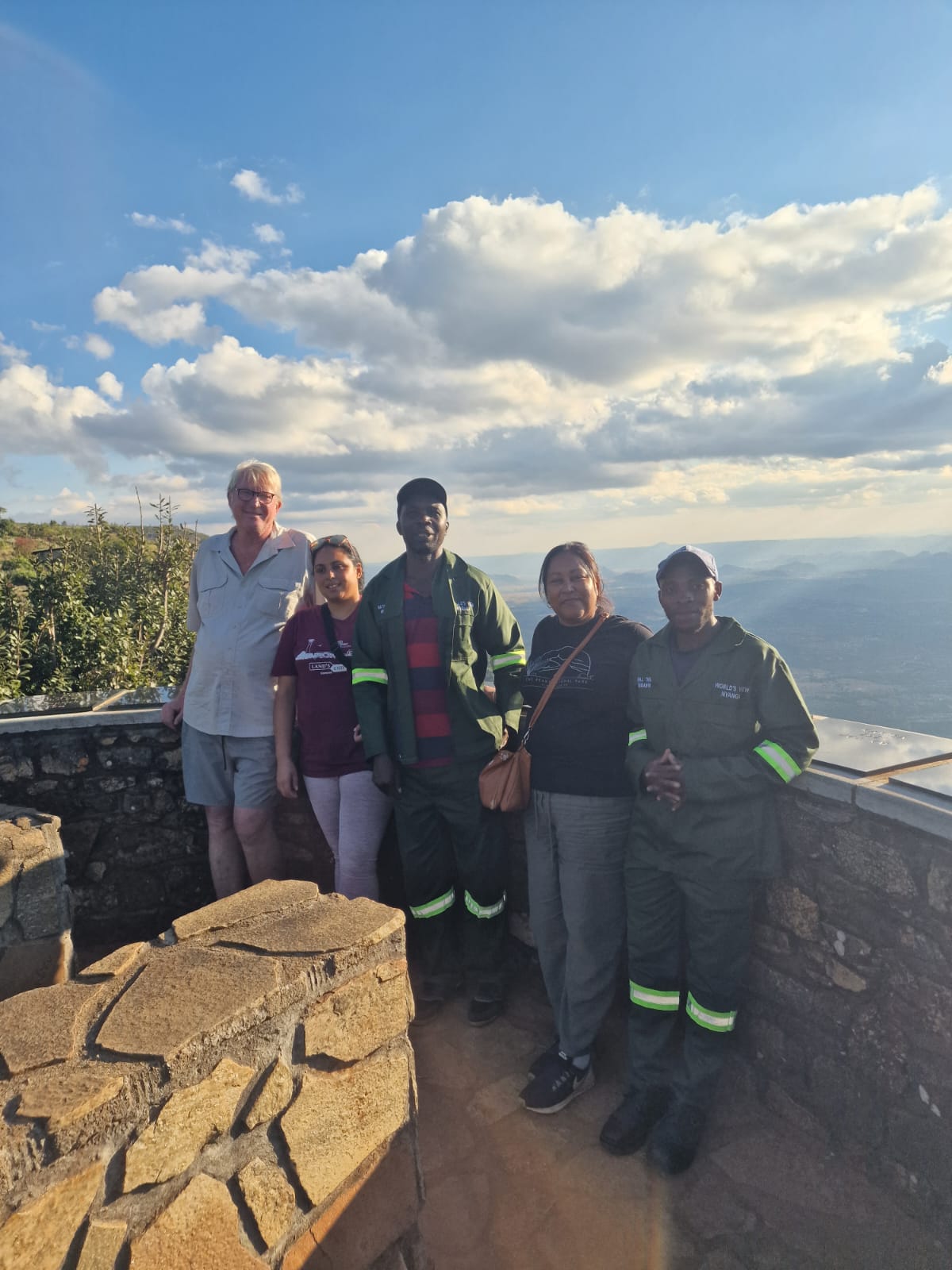
L to R: David, Martina, Matirina Andras, Helena and Noel Kanera
Helen and Matrina spent time enjoying and exploring the property accompanied by long serving ground staff Matirina and Noel. They commented on the stunning views of the surrounding landscape. From where they stood at an altitude of 2000m the escarpment drops 600m to the plain below. The area is particularly interesting for botanists and ornithologists, comprising of vegetation types associated with either the basal granite or the dolerite cap. Of special interest was the Protea and Wild Flower Conservancy established through a relationship with Kirstenbosch, the world famous botanical gardens in South Africa who generously donated the original seeds.
Once back in Harare the Executive met again with Helena and Matrina on 15th May for a post tour de-briefing over a hearty lunch during which Helena and Matrina were happy to share their eexperience and knowledge. They gave the NTZ many inspiring ideas such as highlighting some of our magnificent trees and plants as key interest areas, using QR codes as educational tools and explain rare or significant a species really is, shared details of organizations to approach for funding, suggested using a collaborative approach with local and international universities and creating a new species of orchid or hybrid from the heritage collection for people to purchase and raise funds.
Above all they highlighted that it isn’t just capability that gets things done, it is with passion, love, energy and sense of sharing that get projects completed and over the line. They are an example to us all, fabulous professional passionate people who are making the world a better place.
This was a fantastic opportunity for both National Trusts and our enormous thanks go to INTO for providing the funding to make the highly interesting and informative exchange trip possible. The Tropical Gardens group is so useful, and provides greater insight to how Trust gardens are set up and sustainably managed.
The NTZ would like to acknowledge all the hard work and time feely given by Mr David Cozens, the site manager of Worlds View and an Executive Council member who very kindly accompanied the ladies on their trip around the 3 properties, provided a vehicle, a driver, fuel and accommodation. Passionate about tropical gardens.