


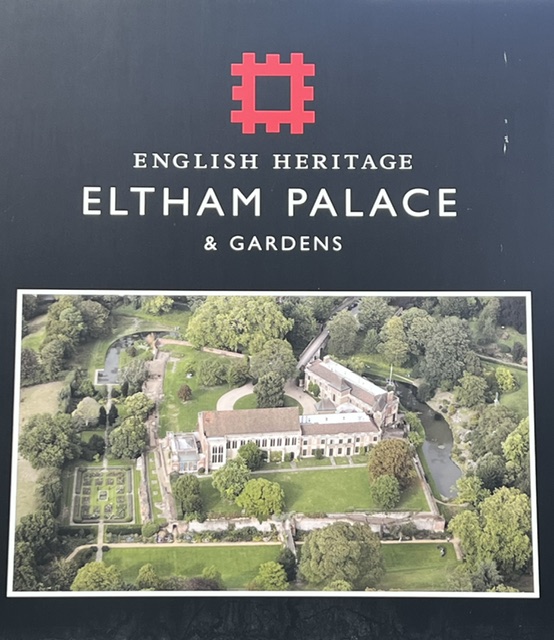
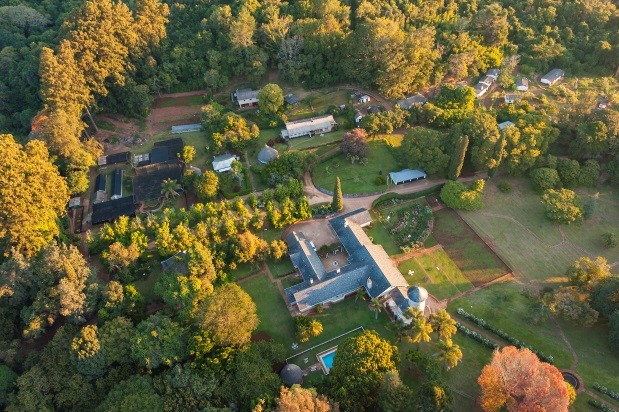
Eltham Palace, UK La Rochelle Estate, Zimbabwe
The late Sir Stephen and Lady Virginia Courtauld moved to Zimbabwe (then Southern Rhodesia) in their retirement years in 1951 after living in Scotland from 1944. They built an architecturally stunning French chateau styled home called La Rochelle Country Estate comprising of 226 acres in Penhalonga in the Imbeza Valley, nestled in the mountainous eastern border area, some 280 km from Harare and 20 km from Mutare. The Courtaulds’ very generously donated the property to the The National Trust of Zimbabwe (NTZ) in 1972.
One of the former homes of the Courtaulds’ was Eltham Palace, located in Eltham in the Royal Borough of Greenwich in south east London after acquiring a 99-year lease on the historic property in 1933. The original part of the palace was given to Edward II in 1305 by the Bishop of Durham: Anthony Bek and used as a royal residence from the 14th to the 16th century. Prince Henry Tudor, who would become Henry VIII, was born close by in Greenwich, spent much of his boyhood at the royal residence alongside his siblings and early years as king Henry VIII. The Palace is owned by English Heritage.
The Courtaulds’ lived at Eltham Palace from 1936 to 1944 over the period that encompassed the second world war spending over two years restoring the medieval Great Hall and building an incredible Art Deco home. Eltham Palace has been used in many historical films and series including the very popular ‘The Crown’’ and ‘Death on the Nile’.
These two amazing Courtauld homes: Eltham Palace and La Rochelle forged a special relationship between English Heritage and the NTZ and we have been enjoying a wonderful relationship with Eltham Palace for several years now: sharing historical information, findings of research projects and talking about collaborative projects in the future.
During a recent trip to the UK Mrs S. Waterworth, NTZ Deputy Chair, took the opportunity to meet our colleagues there in person. Here is her account of a fascinating and delightful day there.
On a very hot and dry summers day in July I was very kindly met by Mr Aron Clay, the Eltham Palace Head Gardener who gave me a personal grand tour of the 19 acres of beautiful historic gardens on the estate. With the estate in front of us he explained the history of the grounds and showed me very detailed management plans that he had been working on. The plans are critical to managing an estate especially one that had several owners with different ideas and the various garden trends of their time: some of which are still evident today in the landscape. He shared his precious collection of historical formal drawings and sketches complete with every ancient tree, garden layouts, design features and plant species all plotted from the Courtaulds’ time right up to the present day.
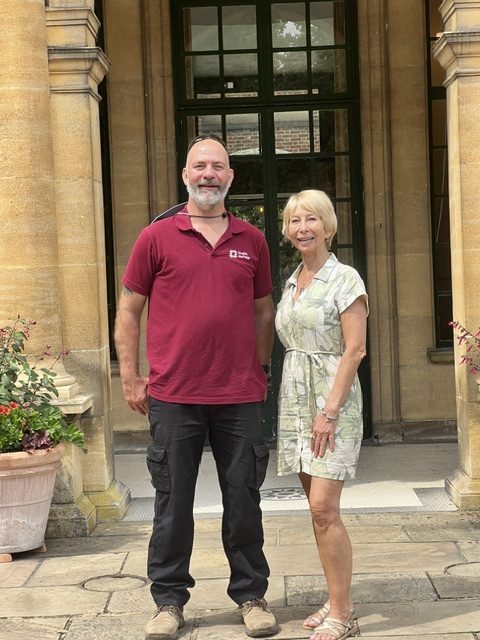 Mr Aron Clay, Head Gardner and Mrs Sharon Waterworth, Deputy chair NTZ
As we walked and talked in the unusual heat Aron explained the Courtaulds’ were looking for a country house not far from London and Eltham Palace ticked all their boxes. They were keen gardeners and eagerly participated in the creation of new gardens drawing inspiration from their travels around the world and from the latest trends in garden design at the time. As we continued I could see the medieval features such as a triangular herb garden woven into the current landscape and found it a fascinating and unique aspect of the estate.
We strolled past formal well-kept lawns, flower beds and topiaries of shrubs clipped into defined geometric shapes and ended up at a sunken lily pond in the Rose Quadrant filled with beautiful displays of historic rose varieties such as Rosa ‘Grucc an Aachen’, bred in Germany in 1909 and hybrid musk roses including R. ‘Felicia’.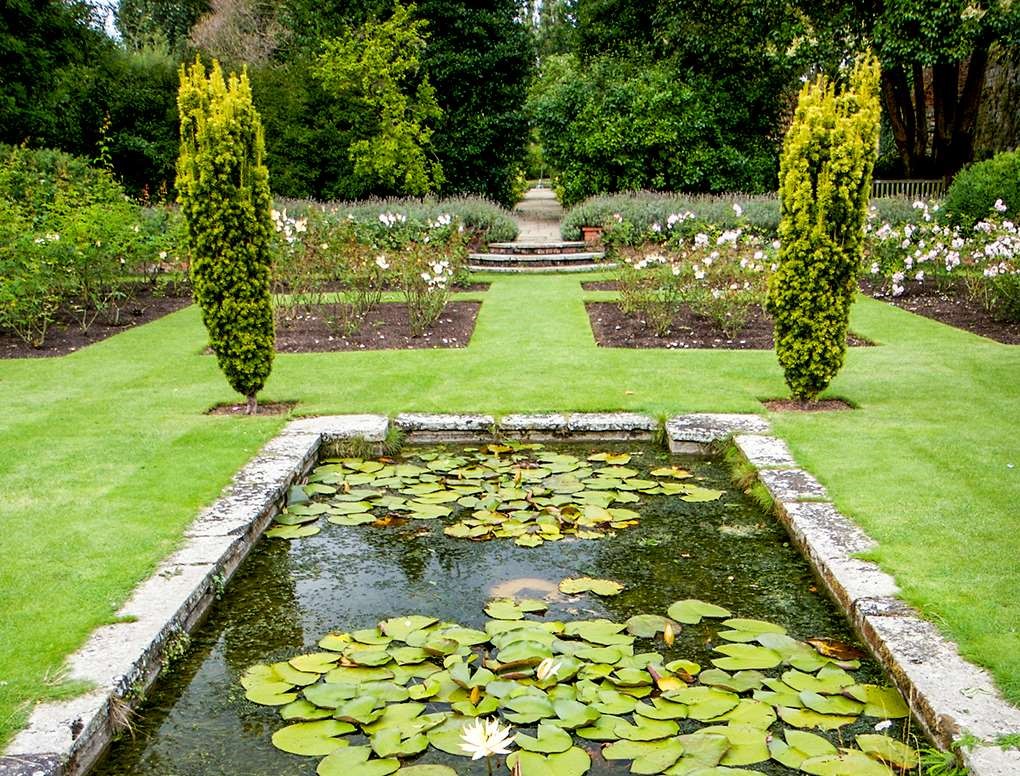
Sunken lily pond in the Rose Quadrant
We meandered through huge ancient oaks (my favourite tree), vital keystone species and symbols of strength with their distinctive heavy, thick twisted limbs and massive round, dome-like crowns. Some of the oaks were standing more or less in a straight line which I commented upon. Aron explained they were not planted by humans but wild sown by nature either by red squirrels or jays storing their annual stash of acorns and forgetting where they all were buried leaving some to grow into new trees. Isn’t nature amazing.
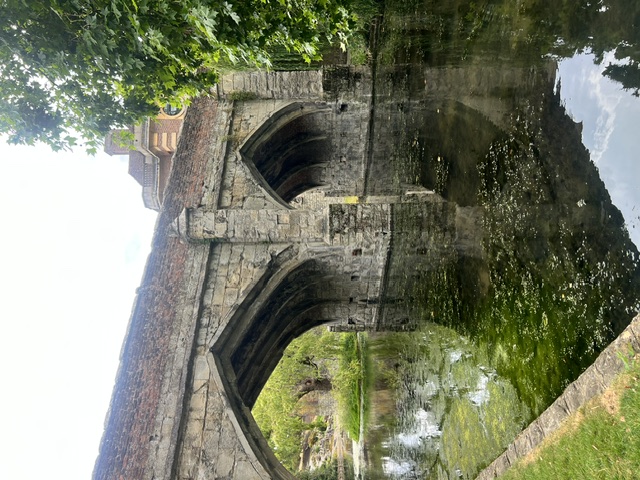 The ornate stone bridge over the moat with the Palace in the background
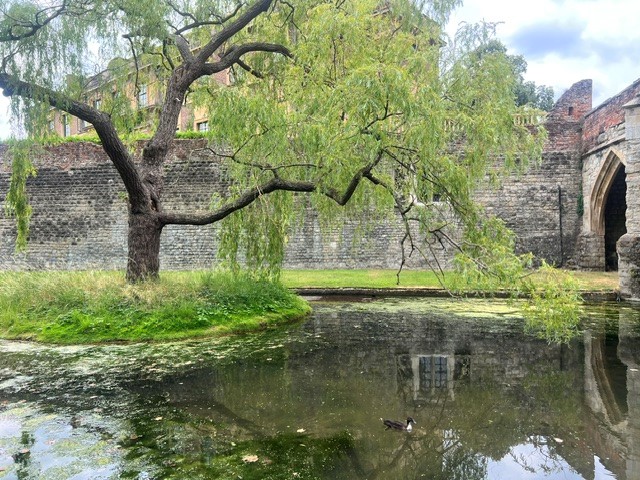
Weeping Willow tree adjacent to the stone bridge with the Palace in the background
We stood overlooking the rock garden close to the house that Sir Stephen commissioned, with its series of pools and cascades running down to the filled moat. He was a keen mountaineer and I noticed the bas relief overlooking the front entrance.
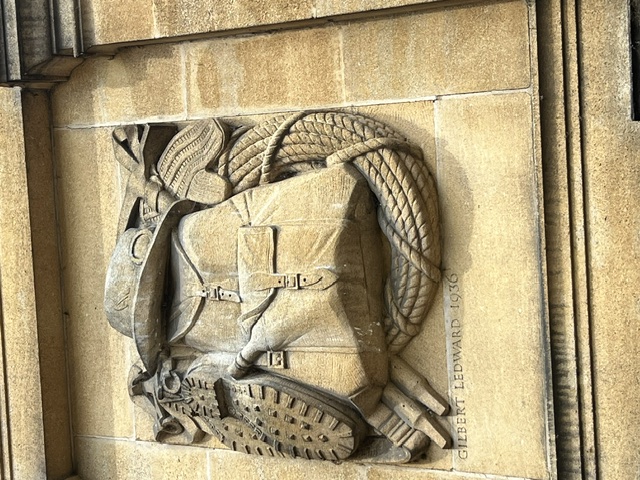 Bas relief with mountain equipment
Aron and I talked over a nice lunch in the glass orchid house that is now a delightful café and he shared his two key visions for the garden that he is working on: firstly, incorporating elements of the medieval palace and secondly an exciting new idea of establishing community allotment gardens, the Palace is located in a busy part of urban London. We were joined by the lovely Hannah Pearson, the Senior Gardener and we chatted about Sir Stephen’s orchid collection. Sir Stephen inherited a life-long fascination with orchids from his father Sydney, a horticulturalist of considerable repute in the UK. When they left Eltham Palace the Courtaulds’ transported their collection of rare, exotic and indigenous orchids with great care to their new home in Zimbabwe. Hannah shared her grand vision of bringing part of the important unique heritage collection back to Eltham thus creating a living link to the Courtaulds’ story, including the and only Lady Virginia orchid (Vanda lombakensis Virginia Courtauld) a rare natural hybrid Vanda orchid named after her by Sir Stephen Courtauld. The NTZ whole heartedly supports Hannah’s amazing vision and we are working towards it becoming a reality.
In the afternoon I had the real pleasure of meeting Dr Andrew Hann, Senior Curator of History (Research Oversight), Conservation, Curatorial and Learning Department He led me into the lavish and elegant entrance Hall of Eltham Palace decorated by Swedish interior designer Rolf Engströmer, with its beautiful curved walls lined in Australian blackbean veneer. Either side of the doorway there are panels of intarsia (inlaid wooden mosaic) showing scenes from Italy on the left and Scandinavia on the right with incredible detail. Shining above our heads was an Ottoman circular reinforced concrete and glass dome that allows the light to flood into the hall through its concentric circles.
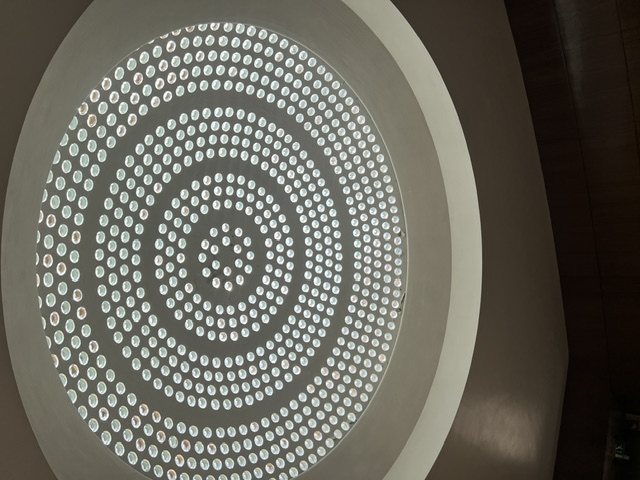 Circular reinforced glass dome in the entrance hall
Peter Malacrida, the Italian aristocrat designed most of the key interiors in the house and also of the art Deco furnishings for the Courtaulds’ sumptuous motor yacht Virginia, launched in 1930.
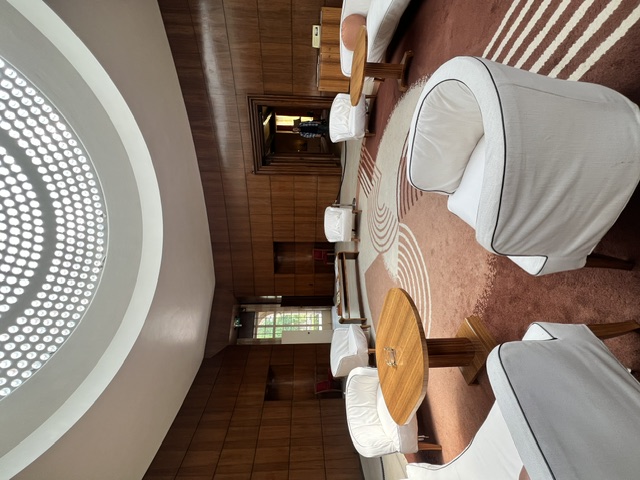
Furniture by Barnett Cohen and Sons of Shoreditch, London
The architects Seely and Paget were commissioned to build the house and restore the Great Hall and create a modern home attached to it. This was controversial at the time because they wanted to build it on the ruins of the medieval Eltham Palace and incorporate the surviving great hall, needless to say the project was a success and recognised as a masterpiece of 1930s design. This no doubt due to the fact that Seeley and Paget were keenly aware of the historical significance and sensitivity of the site which had been an important royal residence for over 300 years and took inspiration from Sir Christopher Wren’s restoration of Hampton Court Palace, designing a house ‘in Renaissance-Classical style, employing brick and stone’, which would be of two storeys only so as ‘not to dwarf the old hall’.
As we strolled along the upstairs hallway, with many bedrooms leading off it, Dr Hann pointed out the window and showed me some pretty complicated reinforcements that were carried out necessary in order to give the required span with little rise, so as to leave the dormer windows of the Tudor wing open to view and so the new glass dome did not block their view.
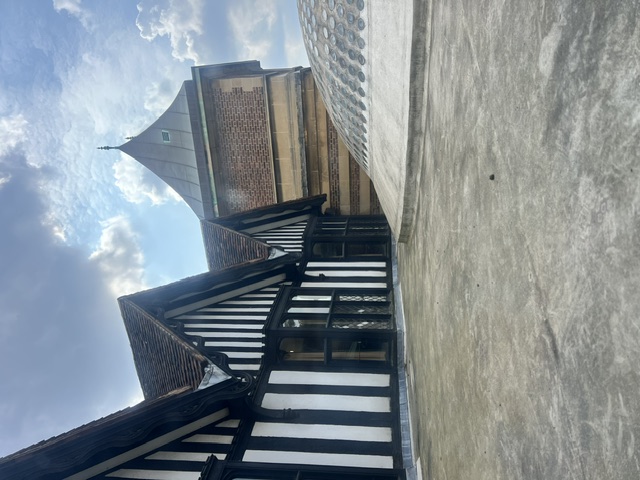
Dormer windows of the Tudor wing and the contrasting modern glass dome on the right hand side
Without a doubt my favourite bedroom was that of Lady Virginia, opulent and beautifully designed with every little detail perfect down to the gold phone and the extravagant bathroom. Above the bath is a statue of ‘Psyche’ which is displayed within a gold mosaic niche by Peter Malacrida. I felt very privileged to be in her private space.
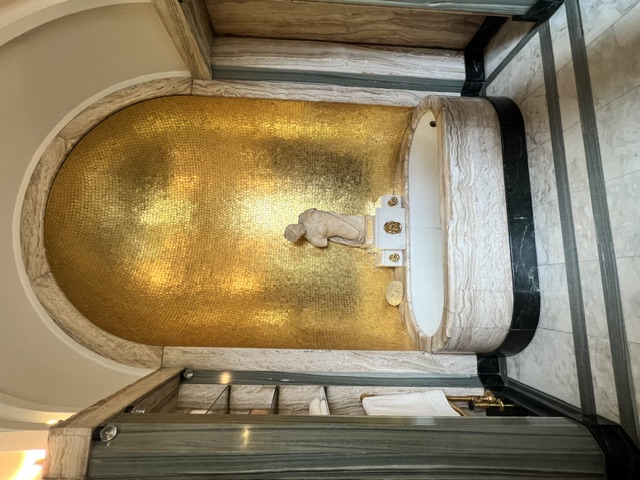 Lady Virginia’s bathroom
The Courtaulds famously shared their home with a ring tailed lemur called ‘Mah-jongg’ whom Sir Stephen had bought from Harrod’s in central London as a gift for Virginia and he became her constant companion. Mah-jongg who had a specially built network of tunnels in-between floors and had his own especially decorated and centrally heated upstairs suite with a hatch and a bamboo ladder leading down to the ground flower room that he could run around and play in.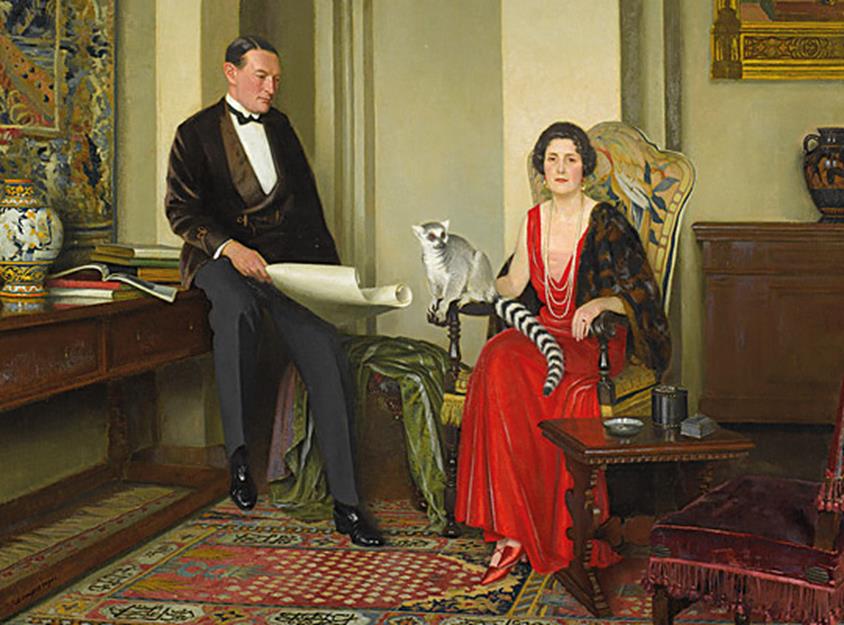 The Courtaulds with Mah-jonng
Mah-jongg accompanied them on their travels aboard their luxury yacht and when Mah-jongg died in 1938 he was buried in the garden of Eltham Palace and a specially designed memorial obelisk made from Delabole slate and Portland stone was placed over his resting place, designed by Gilbert Ledward who also cast the metal relief on the base. Years later, Mah-jongg’s remains and the obelisk were taken from the garden at Eltham and re-located to La Rochelle close to the sunny veranda overlooking the rose garden
.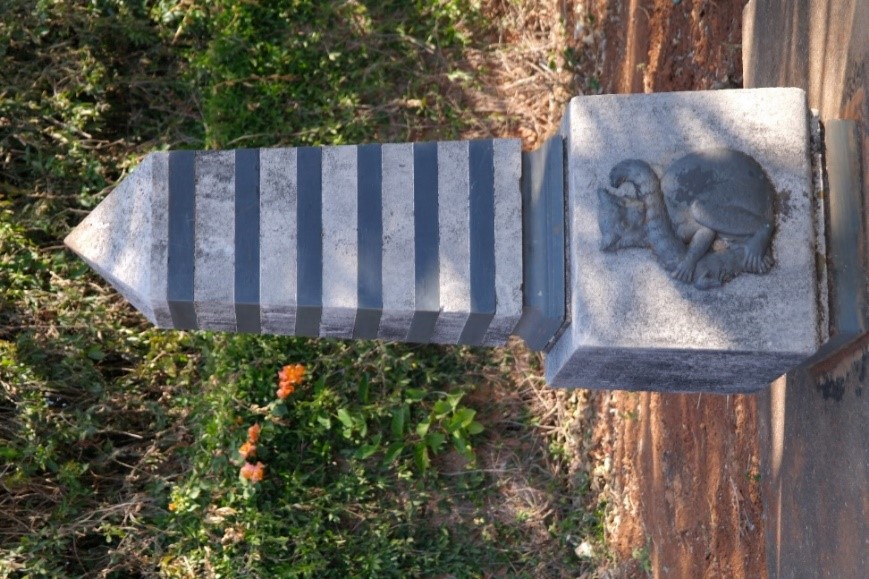 In memory of Mah-jonng: stone and slate obelisk in the gardens of La Rochelle
Dr Hann guided me onto the enormous Great Hall, built by Edward IV in the 1470s, which is the only surviving part of the medieval palace and we stood on the minstrels’ gallery across Eltham Palace’s magnificent Great Hall. As I looked up and admired the glorious hammer-beam roof built for Edward IV more than 500 years ago, the intricate details and historical significance I had feelings of admiration, respect at the workmanship, design and pride too.
Restoration works undertaken by the Courtaulds’ included reopening six blocked clerestory windows, repairing oriel windows, reinstating stone coping, overhauling the roof, installing stained glass work, installing electrical lighting, a new floor laid with underfloor heating, replacing the east end screen and minstrels’ gallery above, and installing a screen and canopy at the west end.
Inside the Great Hall 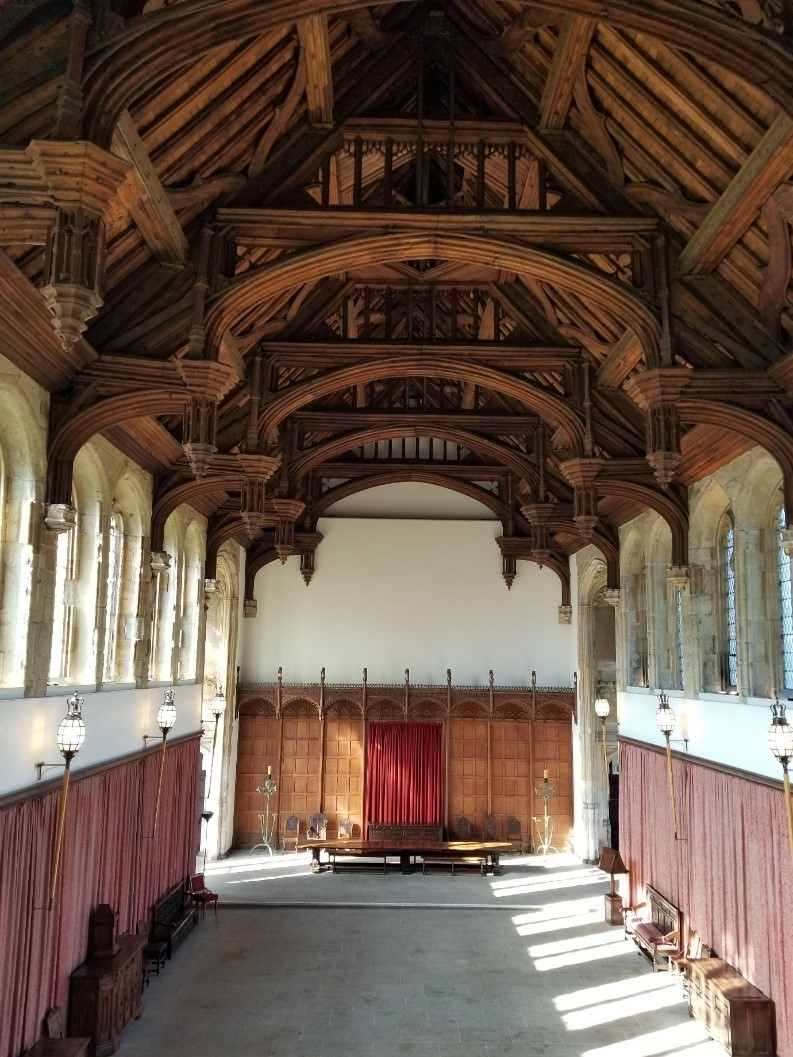
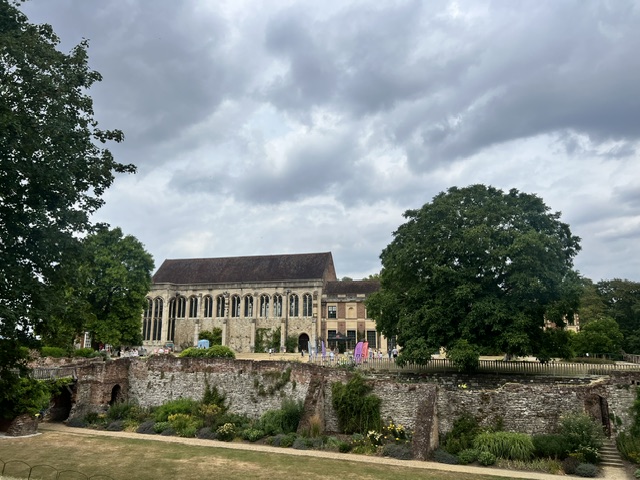
Outside The Great Hall
The screen and canopy at the end of the hall were supplied by Islington cabinet makers JL Green and Vardy. The carving on the canopy, modelled on the screen at Attleborough church in Norfolk, was by Graham and Groves, who also carved the new wooden bosses for the vaulting in the two bays, replacing damaged stone bosses. 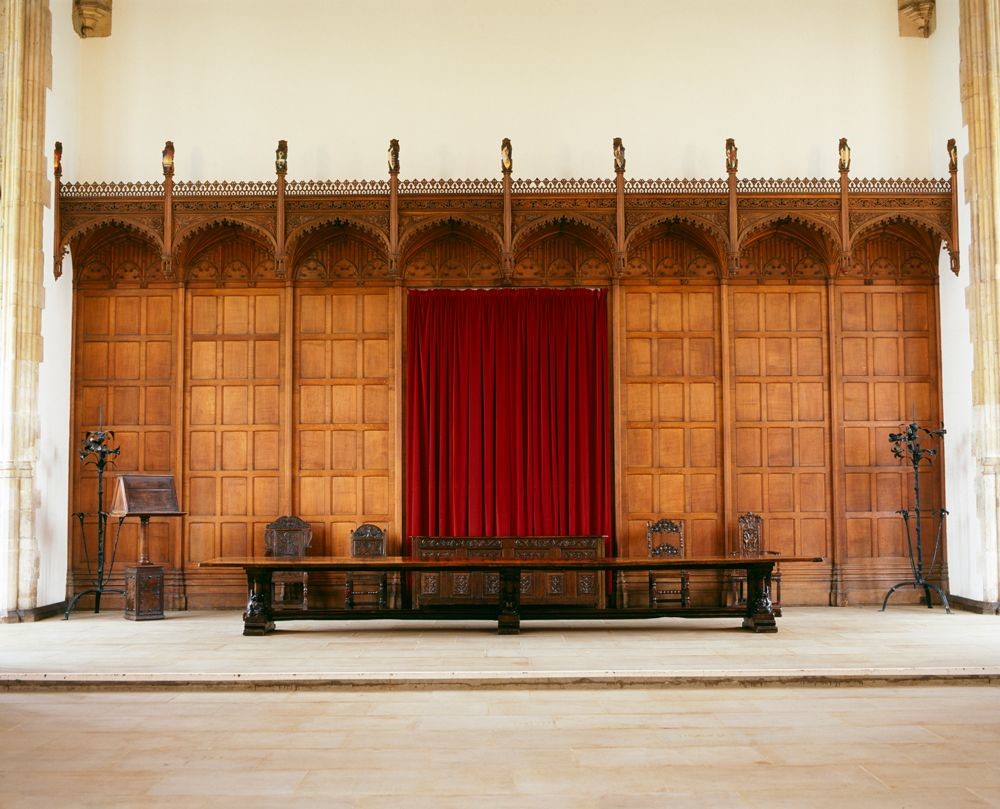
Bas relief in the Great Hall featuing Mah-Jongg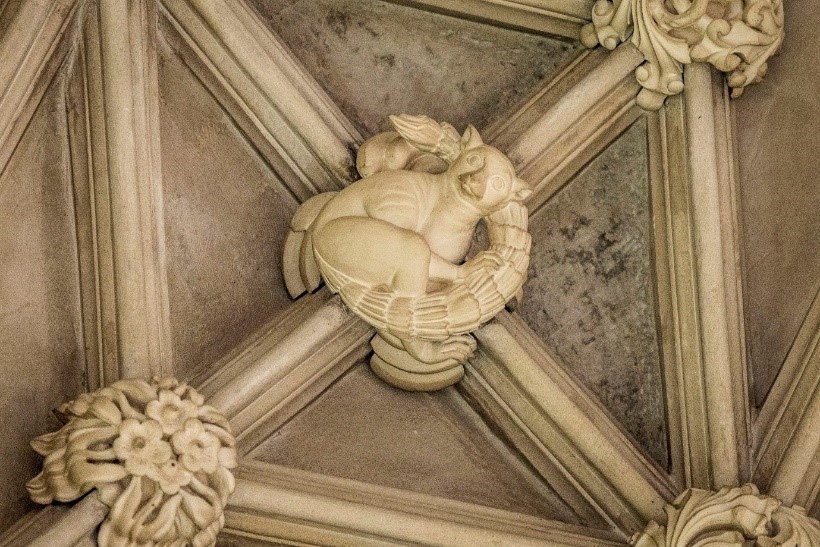
I then had the real pleasure of meeting with Ms Sabrina Villani who is the Curator of Collections and Interiors and we had an interesting talk and shared our individual knowledge of the Courtaulds’ lives and their famous collections including sculptures, fine art paintings by master painters, rare orchids, gem stones, carpets and coins. I shared my observations on the similarities between the two grand homes.
Both are architecturally spectacular: Etham Palace is an incredible modern Art Deco design whilst La Rochelle is described by a leading Professor of Architecture as:
“La Rochelle is a rare example in Africa of a major early Modern Movement (in architectural terms) private house, and almost unique in Zimbabwe, given the quality of its architectural detailing and of its interior decoration, especially in the Fantasia room and the Peacock cottage.”
The Courtaulds’ frequently entertained important and wealthy guests on a grand scale and it is very clear that both homes were especially designed to ensure their ultimate comfort with all the mod cons of the day. Both homes have a sprung dance floor, outdoor swimming pool, summer house and art collections. Both gardens were crafted and planted with the assistance of Kew Gardens and Royal Wisley Horticultural Gardens. Mr John Mitchell, formerly the head gardener at Eltham Palace, travelled out to La Rochelle to design the broad layout of the gardens and remained with the Courtaulds ‘for four years until 1955. Both historical gardens have winding rivers, streams and dams, arboretums, herbaceous borders, pergolas, rose gardens, orchid houses, ornamental ponds and herb and vegetable gardens to serve the kitchen’s needs.
Distinguished visitors at La Rochelle were asked to engrave their signatures with a diamond-tipped stylus on the two large end windows in the house. Over a 7 year period 3 volunteers painstakingly identified and documented 898 of the signatures of guests between the period 1954-1970 and published a book that provides a captivating historical glimpse of signatories ranging from African nationalist activities, political figures from various parties, prominent musicians, dancers’ actors and artists, historians, British aristocracy, local residents and more (available ntoz.org). Imagine my surprise when Dr Hann informed me that a signed window pane from Eltham, on loan from the Courtuald family, includes several inscribed signatures including those of Queen Mary and Elizabeth, Duchess of York.
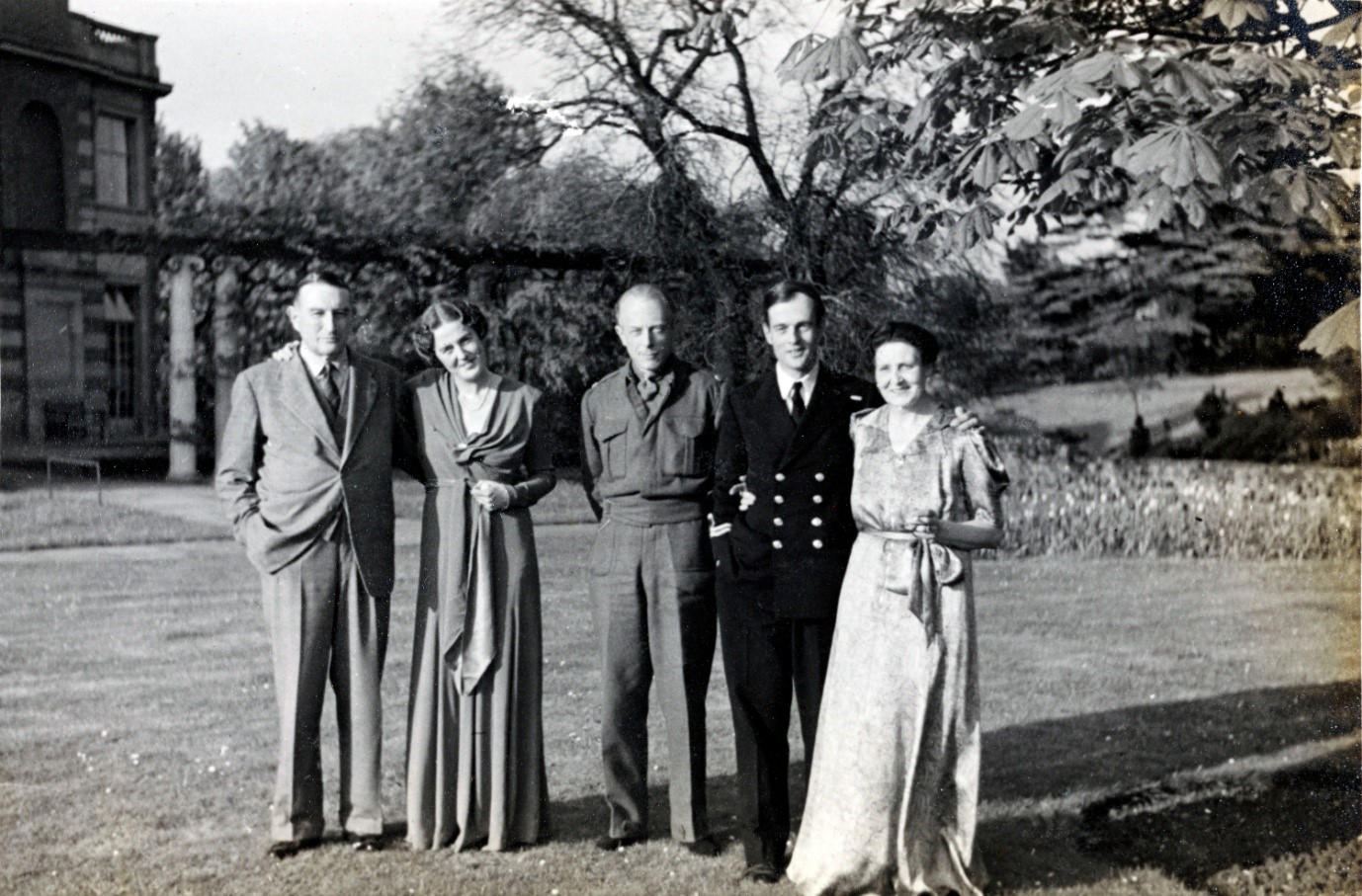 Sir Stephen, Mollie, George, August and Lady Virginia Courtauld in the grounds of Eltham Palace in World War II. George and August were Stephen’s cousins
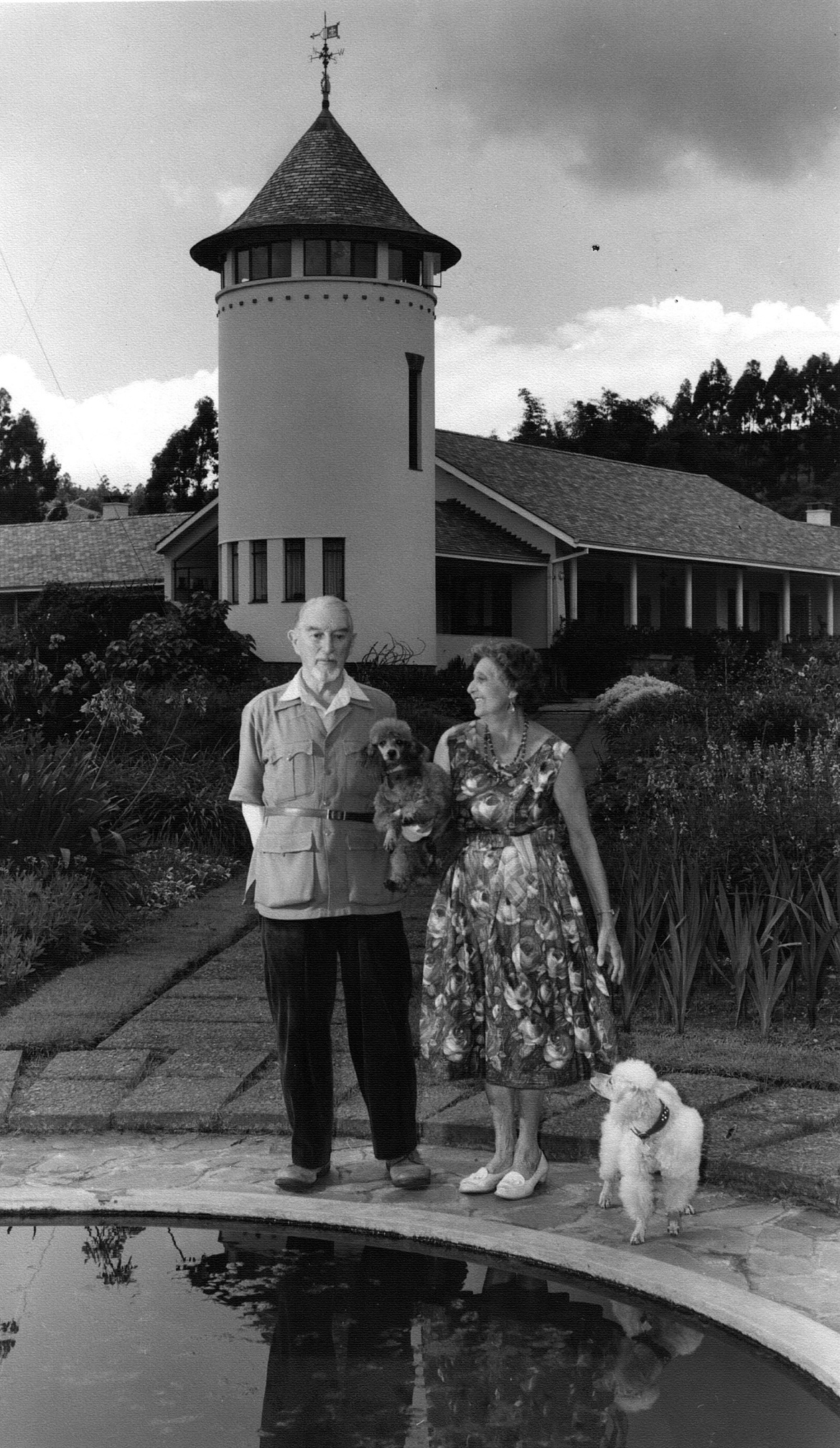
Sir Stephen and Lady Virginia by the fish pond at La Rochelle circa 1963
Sir Stephen passed away in Salisbury (Harare) Zimbabwe in 1967 at the age of 83 following the amputation of his second leg. Lady Virginia stayed at LAR until 1970 when after a period of ill health, she moved to Jersey where she passed away in 1972. Her ashes were flown out and reunited with Sir Stephens at the base of the tower of their beloved home.
A tale of two homes: the Courtaulds’, great philanthropists who bequeathed their homes with all their treasures onto English Heritage and NTZ and in doing so they have inspired so many people and left their amazing legacy and history for future generations to enjoy.
I would like to express my sincere gratitude to Dr Hann, Aron Clay, Hannah Pearson and Sabrini Villani for extending a very warm welcome to me, for their professionalism, sharing their expertise with me and for their incredible passion for Eltham Palace. It is a real privilege to work with you all and I sincerely look forward to hosting you at La Rochelle once day soon.
References
Mr B Mennell, The National Trust of Zimbabwe and Acumen (2015): Visitors guidebook: Last home of Sir Stephen and Lady Courtauld
Photographs courtesy of Eltham Palace and National Trust of Zimbabwe
https://www.english-heritage.org.uk/visit/places/eltham-palace-and-gardens/