New Plaque for La Rochelle

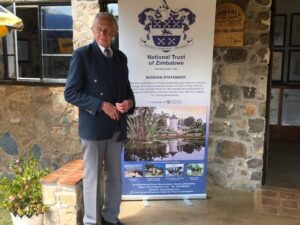
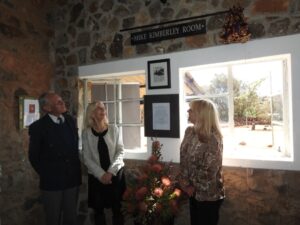
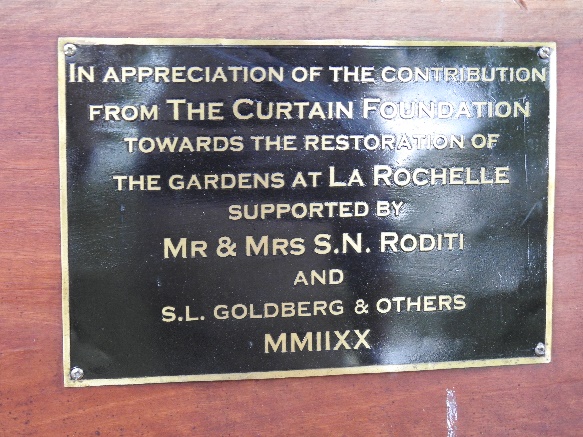
The Trust is deeply indebted to Mr H Leared of the La Rochelle Centre for replacing the timeworn National Trust plaque.

The new plaque, set on a copper plate, reflects the re-branded National Trust logo and colours (from green to blue).

It looks perfectly placed on the court yard wall of La Rochelle Country House and Spa!

The iconic metal sculpture in the fore ground was created by Cedric Green in 1961 who was a man of many talents. In addition to being an architect, he designed Lady Courtauld’s private pavilion known as the “Fantasy Room”, he was also a sculptor.

Originally entitled “Survivor” the sculpture is now affectionately known as “Don Quixote”.

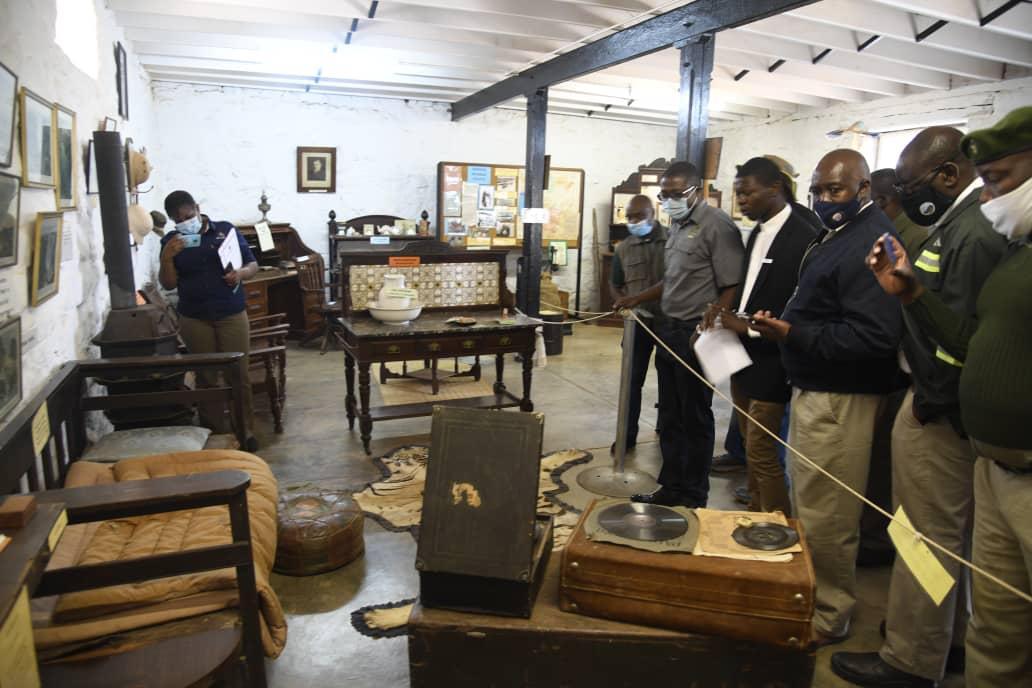
Annual Report for Rhodes Nyanga Historical Exhibition: April 2019 to March 2020

I wish to extend my appreciation to Mrs Merle Moore (Vice Chairman), Mr Geoff Hawksley (Treasurer), Mr Marshall Nyanhanda (Curator) and all Committee Members – past and present –  for efficiently maintaining the smooth running of the museum.

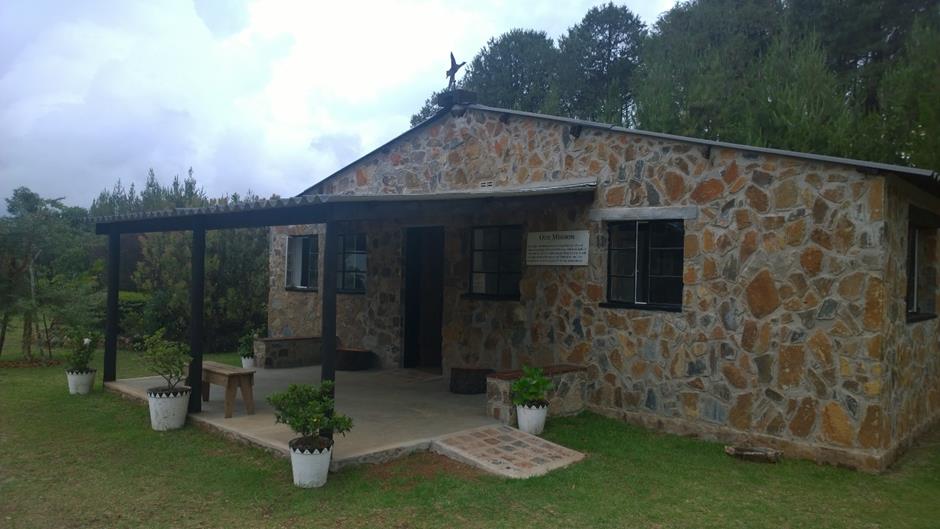
The display depicting the history of the Nyanga Churches and Missions was slowly expanded and improved, with further research undertaken and photographs added.

It is the intention of the Committee to undertake Heritage projects whenever possible.  In 2018 we were invited to join with Uganda and Sierra Leone in an INTO cross-border competition which encouraged children to question and do research into customs and traditions.  It would be almost impossible to organise a project such as this in the Nyanga area without a ‘liaison officer’ who is in contact with every school.  We are most fortunate to have as an ex-officio member, Mr W Dhlandhlara (SOLON Foundation), who fills this position for us, and enabled us to participate in this project.


Pupils from the Heritage Clubs were encouraged to create a short video depicting their chosen subject, using a cell-phone.  Some worked in groups and others individually.  The videos were judged initially by a local panel and the best submitted to a panel of school children.  The three videos with the most votes were submitted to the INTO group.  The best videos were shown at a Prize-Giving Event organised by Mrs Moore and Mr Dhlandhlara.


Welcome speeches

Mr W Dhlandhlara                           Mrs M Moore, Vice Chair

NTZ and SOLON funded the lunches and Mrs Waterworth organised the certificates.  There were monetary prizes which went to the Heritage Clubs, and three individual prizes.  Our gratitude goes to INTO, the teachers involved, Curator, the judges and committee members and to NTZ Councillors who attended the event.


First prize:  St Monica’s School with Mr Dhlandhlara, Mrs E.A Logan Chair, Mr D Scott Executive Chair

                                                                                      Second prize: Nyatate School

Proud Runners up

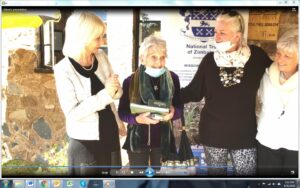
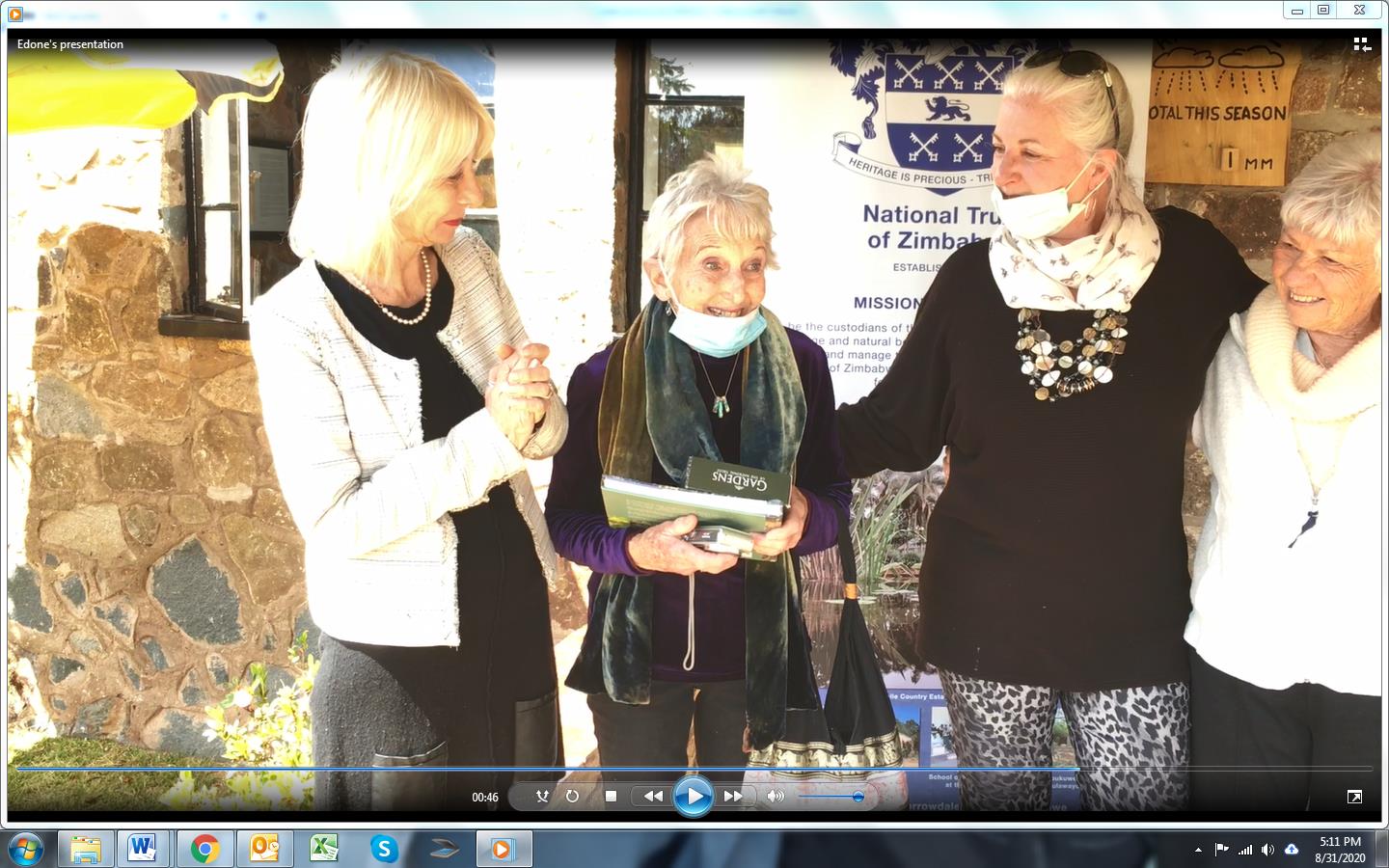
Mrs Waterworth, Executive Vice Chair, then presented three educational

books that were very kindly donated by the Solon Foundation.

Following the lecture and journey of exploration in 2017 to Nyanga North to visit the homes of early Nyanga Sculptors by Dr Jonathan Zilberg, (Associate Research and Scholar for African Studies), the family of the late Jonathan Matimba offered Jonathan’s work to RNHE for display.  Dr Zilberg and Rob Burrett assisted with the funding of the project and the works of art were transported to the museum in August.  This culminated in an Open Day and Exhibition of the works of Jonathan Matimba and local sculptors, who were given the opportunity of displaying their work at the exhibition; some sales were made.  Dr Zilberg spoke to the large gathering of visitors and artists on Nyanga’s early sculptors, explaining different styles, materials and techniques. The Committee is now discussing how the widow of Jonathan Matimba can receive some reward for the loan of the works of art. Dr Zilberg presented RNHE with one of the wooden sculptures – The Yawn Dog.  A professional video has been compiled by Iain Macdonald as a valuable record of this important event.

Dr Ines Grainger donated the funds for a new sign for the door of the Grainger Room to commemorate the 100th Anniversary of the birth of Don Grainger.  A summary of the life of Don Grainger was printed in the John Galt Gazette.  This excellent local publication advertises free of charge, monthly news from RNHE and articles of general interest re recent displays, etc.

The Curator and Student on attachment have updated the inventory documentation and donation records on the computer.   They have prepared most books in the Grainger Reading Room for cataloguing; this project needs to be completed and students encouraged to make use of the excellent collection of books for research purposes.

As public interest increases in the museum, so does our opportunity of spreading information and helping to make the world a better place!  Mrs Matimba was given a wheel-chair from Rotary, through Council member Clare Peech, as a result of the sculpture exhibition.

Dr Ines Grainger donated copies of her Women’s Club recipe books to a club organiser in Harare who visited RNHE, for use by her members.

Rob Burrett’s historic booklets have become ‘best sellers‘ from the museum shop, with some visitors asking for the latest publication to add to their collection.   Rob has also written an excellent booklet for schools on Rock Art, funded by the French Ministry of Foreign Affairs, particularly for the Mukuvisi Wooklands Environmental Project.  400 copies were given for distribution to Nyanga Schools.

As a result of our enquiries and research into the history of the Dutch Settlement, an excellent illustrated document has been written by someone who grew up in that area in the 50s/60s, which can now be used for information on this previously un-documented area and era of Nyanga’s history.

Visitors have requested more information on the Natural History of Nyanga, and the Committee is planning a display to depict this.

As a grand finale to our year, we moved, with great difficulty, a Portable Steam Engine donated by Aubrey Logan, from Juliasdale to RNHE, with the assistance of Mr Steve Lapham,  Mr  Sibanda of National Parks and his tractor driver,  the Curator and a number of good, strong men! The renovated and painted Engine (exported from UK to SA in 1903 and pulled by oxen to Bindura district in 1904) is happily settled in the Wagon Shed, next to the Ox Wagon.

Good wishes go to Marshall Nyanhanda with his studies by correspondence for a Bachelor of Science honours degree in Development Studies – under the Faculty of Social Sciences.  We have enjoyed the company of our student on attachment Meshullam Mudzedze, and will miss her presence at the museum.  She has worked well and matured in confidence over the past ten months, and we wish her well as she continues with her studies in Archaeology, Museum and Heritage Studies.

Our thanks go to Management and Staff of Rhodes Hotel for their support of all our projects and for generously lending their cups, urns and chairs for functions.  The Hotel also accommodates the Curator and his family, for which we are most grateful.

To David Scott, Sharon Waterworth and the members of the NTZ Council, our thanks for your continued support and advice.  Our thoughts are with Mrs. Helen Hyslop as she struggles with health issues.  Helen advised and encouraged us through those first difficult years, and we miss the contact with her.

In stepping down as Chair, my very best wishes for the future go to the new Committee of the RNHE, may you gain as much enjoyment and satisfaction from your museum work as have Aubrey and I !

Edone A Logan, Chair, April, 2019

Footprints: I am indeed awed by what Edone, first Chairperson of RNHE, and Aubrey Logan and their successive committees and donors have achieved to make such a remarkable museum. The RNHE is the only NTZ museum in the country:  it is our duty to maintain and develop it as a unique showpiece.

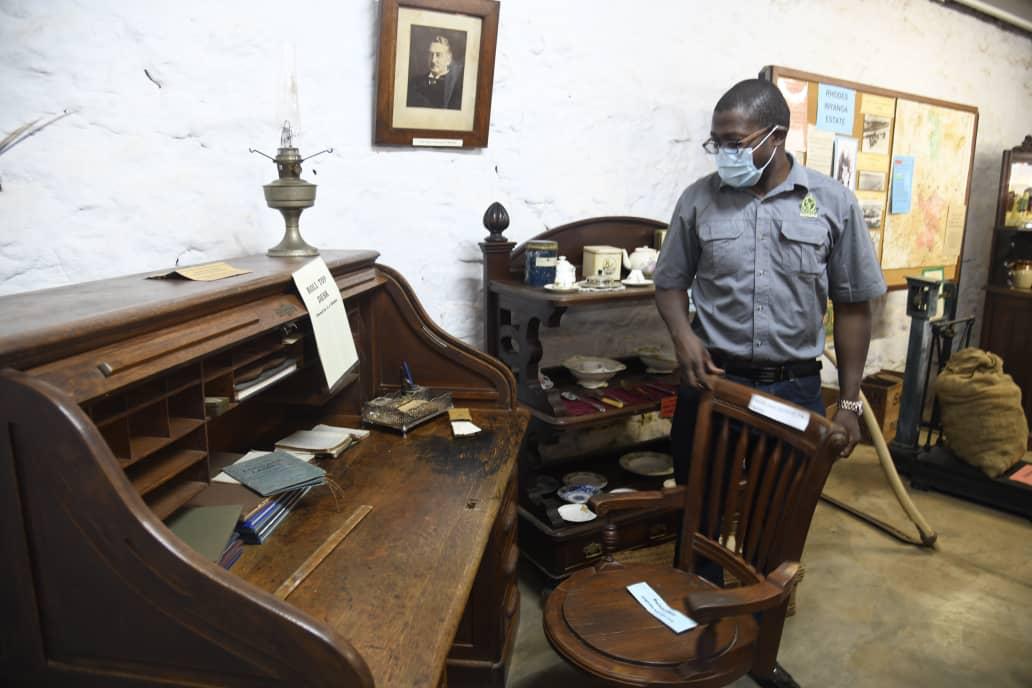
The present path: Numerous donations have graced our shelves, floors, nooks and crannies over the past year:  the Punch Library of Humour from Merle Moore and her late husband Nigel; a 170-year-old executive desk first owned by Sir Benjamin Greenacre, Mayor of Durban, and latterly by his (recently late) great-grandson John, from whose collection of 18 exquisite chess sets a fascinating African one, made of intricately-crafted wire, was chosen for the Museum. The magnificent, wondrously carved ‘Greenacre desk’ now serves proudly as our grand Reception desk.

Much care has been taken into rejuvenating our small entrance garden, litter collection, labels and signs, and the Curator’s unsolicited restoration of wooden railings all add to a positive ambience and attract favourable response.

Hearty tribute is due to our small, determined and enthusiastic committee for their constructive ideas, practical input and generously-given time over this past year. We have been delighted to welcome Nyasha Makanza – Manager of Rhodes Hotel to our ranks.

Challenges: The shortages of fuel and rapid decline in value of our local currency over the past year have had a catastrophic impact on our attendance levels, particularly by school parties:  schools (and parents) have to budget for ‘outings’ and educational trips well in advance but, by the time they arrive, our very modest entrance fees have become unaffordable for them and we do not have the heart to turn them away.

To be of real use and amongst the greatest of such needs is to be educational. To be of educational value – to old and young – means more than being merely ‘fascinating’ or cluttered. In numerical terms the vast majority of our visitors are young people, eager to be captivated and to learn. We must grasp and build on this educational opportunity within this Museum, as an adjunct to the international award-winning outreach already achieved, led so commendably by Edone Ann Logan and her assistants.

Needs: A Regional Information Centre. A small 50-seater lecture/video-theatre, of simple construction and comfortably appointed with carpeted steps and a large flat-screen TV for chool children, public lectures and functions.  This is something we believe we now need and it’s appropriately educational! Relevant material has already been researched and prepared.

Two other needs are the resurfacing of the Shed’s floor, and replacement of outside steps up to the loft.

Projects:  We are planning a new brochure – one which we hope will ‘capture’ people irresistibly. With this in mind, we have had a lot of photographs taken professionally both in, and of, the Museum – photographic ‘hints’ of what is to be found here.

Something we are striving for in Rhodes Museum is to achieve a balance in what we display. It is important that we portray significant players and events in our history from Lobengula to Tangwena, from Welensky to Mugabe, from the Mashona rebellion to the liberation struggle – all as part of the boundaries laid down by Rhodes 130 years ago.  We have been awakened to this need, surprisingly, by children visiting the Museum who say, “Who were the people ruling this country before Independence in 1980? We want to see them and know about them, too.” Boundless scope here for additions to the informative Time Line already set up – and for our video theatre!

The Nyanga region is home to a variety of creative crafts-people:  here are to be found wood-carvers, sculptors, weavers, nurserymen and furniture-makers. One of our projects is to give such people the greater exposure they deserve, by holding on-site ‘Craft Days’ over public holidays when visitors can see them at work (and hopefully buy).

One aspect of Nyanga’s history which has been largely overlooked by our Museum is the “Old Dutch Settlement” of Nyanga North, dating from more than a century ago. We mustn’t allow this significant part of our local history to slip into oblivion.

Finally, we here in Nyanga live in a paradise of wild flowers. One of our hopes is to celebrate this natural beauty, in Rhodes Museum, by displaying copies of Mary Clarke’s comprehensive and meticulous paintings of local indigenous flowers – perhaps those relevant to each month.

GUY CARY, Chair, 2019-2020

Annual Report: 2019 La Rochelle Estate

La Rochelle Estate

Country House and Spa

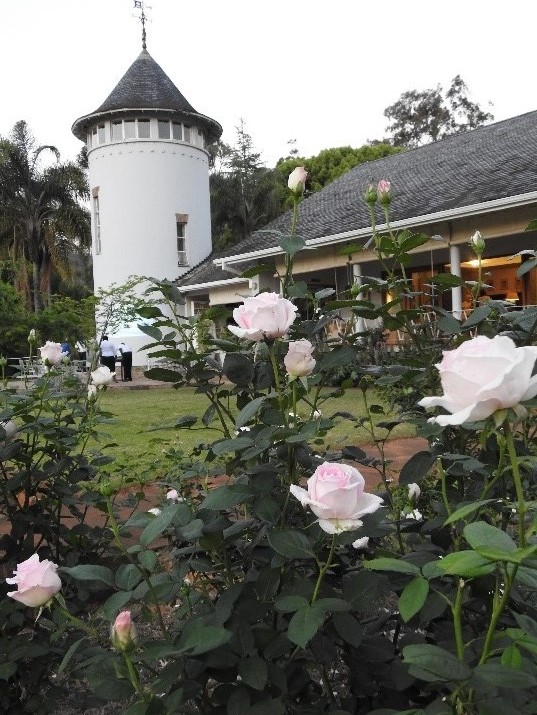
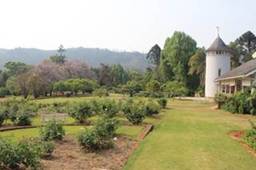
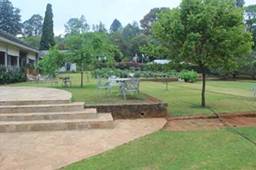
The La Rochelle gardens continue to amaze us with their beauty. Here pictures of the gardens and the rare and wonderful findings we see on a daily basis..               

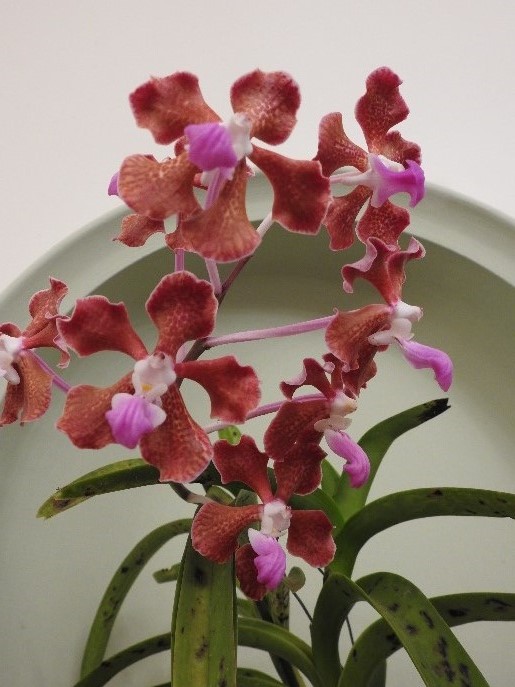
The unique Lady Virginia orchid flowered again in late 2019. The orchid was discovered by Sir Stephen Courtauld on the eastern Java Islands during his travels there sometime before the start of the second world war. There have been no others like it found in the world and so Sir Stephen named the orchid, Vanda lombakensis Virginia Courtauld after his wife Virginia.

The orchid was taken by Sir Stephen back to England where it was kept in a glass house at Eltham Palace. It flowered once then during the second world war and survived when the glass house that it was in was bombed. A small piece of the plant was recovered and re potted. It was then brought to Zimbabwe when Sir Stephen and Lady Virginia moved to La Rochelle.
This is only the fifth time that it has flowered to our knowledge, the last time being in 2016 and before that in 1973.

“Garden to plate” – we love serving our guests fresh, organic vegetables from our garden.

Our main focus for 2019 was to expand the La Rochelle vegetable garden. We are now able to feed our guests fresh, organic, homegrown goodness and we are thrilled.


Herbal Tea Tastings have become a favourite activity for guests at the hotel where they get to taste fresh, healthy, herbal teas picked straight from the organic farm.

We hope to expand this further in 2020.

La Rochelle Organics

It has been a very busy time for La Rochelle Organics and the team continues to work hard to grow organic herbs of export quality.  The work continues to grow at a rapid pace in terms of field trials, expanding storage and processing operations, number of people employed, crops planted, hectares under croppings and so on. It is amazing what has been achieved.

The total area of crops under production in 2019 totaled 12.30 ha and consisted of the following varieties:

Crop La Rochelle Farm
Calendula 3.00ha
Melissa 2.30ha
Peppermint 1.20ha
Spearmint 1.50ha
Stinging Nettle 3.10ha
Forage sorghum – Compost 1.20ha
Total hectares under cropping 12.30ha

In the picture below you can see calendula, spearmint, stinging nettles and safflower.

Crops grown commercially in 2019 include the following:

 Stinging nettle organic


Initially it took time to establish and its potential was doubted. However, over time it was realised that it is a hungry feeder with a high irrigation requirement. Consequently both nutrient availability in the soil and water/irrigation methods was improved and it has since started performing very well.

Mint organic

This type of mint is the most challenging to grow in this area. It is the most susceptible to disease and plant stress. Growth problems that we have mentioned earlier in this report and are addressing with Melissa are:

  • A high Nematode count in year two of growth resulting in root damage.
  • A secondary infection of Fuserium and

Calendula Organic                         

Calendula is a good crop for our rotations. However, seed can be a challenge as we collect our own seed, and this reverts back over 2 to 3 seasons. As a result, we continually have to bring in fresh seed for planting. It also has a high labour requirement for harvesting. This next winter we will plant not only to reap petals, but also full flower heads as this is what the market is requiring.

Spearmint organic and peppermint organic

We have now been inoculating our planting material against Sclerotinia and Fusariumusing Trichoderma. We have noticed a major improvement on the disease pressure and tonnage harvested at first cut.

We have also been conducting trials on field mints provided by Martin Bauer. Samples of these have been sent and we understand that they do not fit the specific taste profile required by the customer. We are however keeping these in our parent plant stock if this should change in the future.

In addition to crop production Organic Africa has established a successful educational programme aimed at small scale farmers. The main subjects of study are ecology, sustainable farming and how to farm organically. The table below lists the training courses that were carried out in 2019:

Date of training Training covered Number of people trained Trainer
24.05.19 SOP Harvesting ,Drying and Cleaning vehicles 25 Kevin Martin
3-4.07.19 Mabagrown certification and organic standards 44 Doreen Ngwenyama
16.07.19 Spray Protocol SOP 10 Lindsay Reekie
16-18.08.19 Personnel Hygiene 34 Shingai Mabena
26.08.19 Introduction to Organic Standards 22 Doreen Ngwenyama
12.09.19 Fertilizer and plant protection products application 22 Kevin Martin
13.11.19 Toxic weeds and waste disposal 33 Shingai Mabena
16.11.19 Fire fighting training (Basic) 19 Alpha fire aid
09.12.19 Cleaning Procedures and Record Keeping   9 Zviko Machinga
09.12.19 Seed/seedlings traceability and record kepping   9 Lindsay Reekie

Outlook at La Rochelle Organics

For 2020 we are confident to hit production targets.

Trials are still being conducted on new varieties of products as well as organic pest and disease controls. Also biofumigant green crops have been included in the rotations as well as special consideration to biodiversity in the soils and on the farms. Composting operations are planned to increase to 1500 tons this year.

We have started using the new processing machinery and previous contamination and quality problems seem to be resolved. We are also increasing our drying capacity with the increased production expected.


CULTURE GROWS: BETWEEN YESTERDAY, TODAY AND TOMORROW- NAIROBI SYMPOSIUM 2020: 

Mrs. L. Goncalves, Council member of the Trust, and Mr. W. Dhlandhlara of the Solon Foundation (whom we are proud to collaborate with) were both pleased and privileged to represent the Trust at the Nairobi Symposium held in February 2020.

Mrs. L. Goncalves,   Prof. Kilmani Njogu and Mr. W. Dhlandhlara

The event was organised by the British Council and Twaweza Communications in Nairobi, Kenya and held in the stunning grounds of the Botanical Gardens of the National Museum of Nairobi. The Trust would like to acknowledge and extend its deep appreciation to the INTO who very kindly provided the sponsorship for them both to attend.

Ms Jill Coates,Director British Council Kenya 

The core question leading all the discussions at the British Council part of the Symposium was ‘How do youth involvement, contemporary cultural practices and advances in information technology contribute to the overall potential of cultural heritage and how can they lead to cultural heritage interventions becoming more inclusive and engaging with diverse and non-traditional heritage audiences?’

Speakers from a very widely varied group presented their subjects which included such diverse aspects of cultural experiences such as built heritage (buildings, world heritage sites and indigenous sites), intangible heritage such as performances, language, media, folk art, crafts and oral traditions; natural heritage (caves, eco-villages, landscapes) and museums (visual arts, archives, libraries, cultural objectives); and how technology, youth involvement and community participation can increase access to this heritage – and its benefits. The potential for cultural heritage in order to secure livelihoods to enhance social inclusion was also discussed.

Gender inclusivity was also discussed in the various panels, workshops and presentations.

Presentations included:

  • Audience development strategies – with speakers from the UK’s National Lottery Heritage Fund’s ‘Kick the Dust’ project;
  • A lady from Somalia spoke representing the small Somali community in Kenya, who has been instrumental in creating the Awjama Cultural Centre in order to offer the Somali people, in particular the youth who are vulnerable, a chance to maintain their cultural roots whilst living away from their own country. Her project started when she found that the youth of her own Somali society were playing football in the road and had little else in the way of cultural interest;
  • Emily Drani of the Cross-Cultural Foundation-Uganda gave a very poignant presentation saying that ‘cultural identity is in crisis’ and that with social media and technology as advanced as they are, they should be used as modern strategies to teach culture to the youth, with outreach programmes going towards cultural preservation, without losing everything in the homogenisation of ‘cultural diversity’. Youth today are more wrapped up in modern music and more programmes should be developed to give them access to their history, culture etc;
  • Creative and strategic partnerships between cultural heritage and technology – This included a presentation by a South African speaker, Andiswa Bukula of the South African Centre for Digital Language Resources, who is working on a project to ‘collect’ the ‘click language’ Xhosa, in order to capture it, preserve it and make it available on-line to students, as it is only spoken among a diminishing small group of people in South Africa;
  • Cultural heritage for inclusive growth with speakers from Kenya, Vietnam and Colombia;
  • Contemporary approaches to programming for cultural heritage;
  • Cultural heritage and entrepreneurship;
  • In a presentation by the two invitees from Colombia, who spoke through an interpreter, they mentioned that in their very small, marginalised rural communities in Columbia (under ‘Cultural Heritage for Inclusive Growth’), their MIZAK community (like a small tribe) is one of 107 such small communities being encouraged by tourism to embrace their heritage and keep more young people in the communities through encouragement to return to/remain in, their cultural roots.

What makes a legend? A story. The bigger the story, the bigger the legend!

The statement lead to a discussion:

Contemporary approaches – why should young people be interested or involved? When you ENGAGE with them they become interested. Traditional games and stories for example.

Masai cultural traditions were discussed such as the rites of passage for the young men. How do you reach out to collect information and stories from subtribes? Organisers have to rely on local communities to provide contact and information.

Spotlighting rituals – making them available to be seen/shared by visitors/tourists if possible as a way of bringing income to small communities. Selling sustainable fair trade quality products on the market, feeding the community, providing tourists with souvenirs – coffee, creams, lotions etc using locally produced packaging.

Cultural practices/entrepreneurship – can it work together? Maintaining dignity and honour – an avenue to sustainability.

Alexander Lamont-Bishop, the new Deputy Director General of INTO spoke of the National Trust in the UK and it’s history.

He explained how properties can be donated to the Trust in order to have them protected (ie from developers) according to the owners wishes and as Tax saving moves to protect family inheritances etc. and also a way of maintaining green spaces forever.

                                                                                               Alexander Bishop addressing delegates


Concentrating on success stories Judy Ogana who is the National Officer for Culture, UNESCO, Nairobi Office, gave a presentation on a Government funded exercise to preserve Fort Jesus, a World Heritage Site near the ‘old town’ section of Mombasa.

Mrs Goncalves would like extend her appreciation to the British Council and Twaweza Communications for organaising such a successful event.


Elkanah Ong’esa – famous Kenyan stone sculptor

In her report back to the Executive Council Mrs Goncalves pointed out that Culture is not static, it is dynamic!

She highlighted the following points that are especially relevant for the Trust:

  • Cultural art, traditional medicine, ethnic jewelry and music are important factors to consider in going forward
  • Be more involved ‘on the ground’ with more influence in local indigenous cultural heritage preservation
  • Focus on the preservation of sites and buildings for indigenous education, youth involvement, gender equality and in particular aiding women to become self-sustaining and more valuable in their own communities.
  • Engaging the youth
  • Hold Heritage and Craft and Music Fairs
  • Run Heritage ‘hubs’
  • Themed webinars/Podcasts/Social media

Specifically, as members of the INTO, the Trust should center on:

  • Transactional membership
  • Values membership
  • Legacies
  • Green Spaces
  • Natural and cultural heritage conservation
  • Community outreach
  • Volunteering
  • Commercial

The Trust is now working on implementing the theme of the conference:  Culture Grows: Between Yesterday, Today and Tomorrow

We thank you very much for reading this article!


Arms Wide Open: INTO Bermuda – March 2019

Conference Theme: ‘Arms Wide Open’: Strategies for engaging with diverse communities

David Scott, Chair, National Trust Zimbabwe, was very privileged to be able to attend an INTO conference in the exotic location of Bermuda.

Our sincere thanks go to INTO, along with the Bermuda National Trust for the very generous sponsorship without which, NTZ would not have been represented.

Grateful thanks are extended to the following INTO Council members who made this trip possible:

  • Catherine Leonard
  • Oliver Maurice
  • Bill Turner (and his team)

Below are excerpts from David’s report to the Council.

The conference revolved around this theme encouraging all trusts to “look outwards” and “think out of the box about communicating with and providing inclusive services to the wider communities within which trusts operate”.

This forward thinking concept is, in my opinion, of some considerable importance to NTZ which seems to be perceived as “a vestige of a colonial past” and NTZ needs to be attracting the support of the wider community at both NTZ Council and Committee and community heritage/cultural activity levels.

An item of interest to Africans would be the rain water harvesting mandatory requirement by all residences and public buildings. The roofs are all painted white with a special paint and rain water is channelled into reservoirs built under all the houses. There is no fresh water supply (rivers) on the island so all water requirements are from rain water.

Delegates learnt a lot of the history, heritage and culture of Bermuda. The island consists of approximately 65 000 people in an area of approximately 21 sq miles. The Capital is now Hamilton.  We undertook trips to various areas of the island which included the World Heritage town of St Georges (the original capital of Bermuda).

Town Hall UNESCO World Heritage status

The conference was held over a 4 day period during which presentations, and breakout sessions took place in various historical locations. The Opening Ceremony was held in the World Heritage Centre facility. His Excellency the Governor Mr John Rankin, Deputy Bermuda Premier and Minister of Home Affairs the Hon Walter Roban and a video Bermudan welcome from Michael Douglas, a long term resident of Bermuda and various other officials, including the St George’s Mayor and Town Crier.

A typical St George’s street scene

Bermuda is a British Protectorate. We were hosted on the first evening by the Governor at his beautiful residence with spectacular views.

On Day 2 the theme was ‘Open to All – Whose Heritage Counts’. I presented a 5 minute talk on the difficulties experienced by NTZ in the hostile economic and political environment within which NTZ has operated. 3 other delegates gave short presentations on heritage and conservation challenges faced by trusts from Italy, Bermuda and USA. That evening deletes enjoyed dinner at Fourways Restaurant followed by long service awards to Oliver Maurice and Geoff Read for their amazing service to INTO.

Bermuda National Trust manages many sites on the island such as Bridge House and Tucker House.


On Day 3 delegates were given the opportunity to drill down with experts in conservation and to meet with INTO executive leaders on how to make the most of INTO.

The connections of Bermuda are very close from slave trade times and Boer war prisoners:


On the final day there was a round table on the workshop highlights where moderators reflected on the best things they have learned from the conference. Dame Fiona Reynolds closed the conference by giving a very interesting speech and announced the next ICNT host to be: Belgium.

I have included a few extracts from a blog written by Catherine Leonard (CEO of INTO), shortly after the conference which summarises the conference so well:

Three themes

For me, there were three themes running through the conference:

One has been the extraordinary diversity of what the NTs of the world do. We heard stories of biodiversity loss and invasive species, of historic site interpretation and building skills, of managing small islands and climate of heritage inventories and volunteerism; of building membership, fundraising and volunteerism; and of ensuring that the heritage preserved by INTO members fully reflects our communities.  What amazing organisations you all are!

It was a pleasure to share experiences, to listen to committed voices.  To remember that the things that concern us are basically the same.

Stronger together

The second theme is that we are stronger together.  Queen Quet’s song at the beginning “Walk together children, don’t you get weary” set us off on the right path. This was further underlined by Gus Casley-Hayforth who said how important it was to gather as communities and nations to be inspired.  (His speech is also worth a read and can be found here.)

Darren Peacock continued this by saying that no Trust is an island and that everything is connected.  (This was a theme of our 2011 Conference in Victoria where ‘Everything is connected’ is a Coast Salish saying.)

Open arms

And the third part is that we’ve all agreed how important it is to open our arms as wide as possible.

Gus talked about doing the right thing.  I’ve long wanted to quote Professor Dumbledore in a work context as I actually feel this applies quite well to a lot of us: “Do you know why I admire you, Newt? You don’t seek power or popularity. You simply ask, is the thing right in itself? If it is, then I must do it, no matter the cost.

We heard so many words of wisdom from Princess Dana, from being brave enough to say “no” to putting human dignity at the heart of what we do.

Fiona said that this was the most moving and important discussion INTO has ever had and I believe it is.   It hasn’t always been comfortable but why should it be?  We have an important job to do and need to be challenged at times.  Queen Quet talked about the democratisation of heritage “continuation” (rather than preservation, which should be reserved for jarring food!).  Dame Pamela Gordon-Banks was concerned that we don’t reflect the communities we represent.  And Jeremy Harris asked us to think about ‘universal natural rights’ and be more neighbourly with our planet.

The conference was a resounding success in all respects.

Huge thanks go to the community who participated in hosting and guiding conference attendees. The people of Bermuda are very kind and extremely hospitable. For example, the delegates were hosted in private homes one evening for a dinner.

All in all a truly memorable conference thanks to INTO and the Bermuda National Trust.


International Museums Day 2020

RHODES NYANGA HISTORICAL EXHIBITION – Nyanga, Zimbabwe

INTERNATIONAL MUSEUM DAY, 18 May 2020

Equality : Diversity and Inclusion

As we have been marking International Museum Day today, some may wonder how we can incorporate this year’s theme of “Equality : Diversity and Inclusion” within the thick stone walls of a museum named after Cecil John Rhodes of 130 years ago – whose name this country bore for 90 years following white-settler occupation.

If we try to look at that period of our history objectively, we are bound to acknowledge that there was a philanthropic side to Rhodes’s visionconsider the thousands – of all races and many nationalities – who have benefited directly or indirectly from his legacy of Rhodes Scholarships for many decades; and the fact that the very land and premises of our much-admired little museum were bequeathed to this nation, in perpetuity, by Rhodes from his estate.

So, indeed, with Rhodes’s name attached to our museum, we confidently strive for a balance of what we can now regard as equality: incorporating diversity and the inclusion of all Zimbabweans’ interests in what is displayed within its walls. We aim to represent all facets of the rich human and natural resources, and often troubled history, of our uniquely beautiful country, showing how its people of all colours and cultures have contributed to what Zimbabwe is today – as reflected in our recently constructed Time Line covering centuries of local history.

Rhodes Museum has become noteworthy for its outreach work – particularly with regional rural schoolchildren, whose rich cultural heritage has been explored and revived – which has been rewarded with international recognition. At present the Museum houses a striking exhibition of wood-carvings and stone sculptures by the late Nyanga artist Jonathan Matimba, whose unusual, unique works have attracted the admiration of local and international visitors.

Looking forward, the Trust is working towards expanding the role of the Museum and plan to establish a Nyanga Information Centre and a 50-seat lecture-and- video educational facility at the Rhodes Museum, both facilities are sorely needed in the area.

Despite the challenges we are facing we remain, as all museums should, caring custodians of the past and vital visionaries for the future!

Guy Cary, Chairman

CHAIRMAN’S REPORT: 2019 TO APRIL 2020

Cloudburst over the plains below

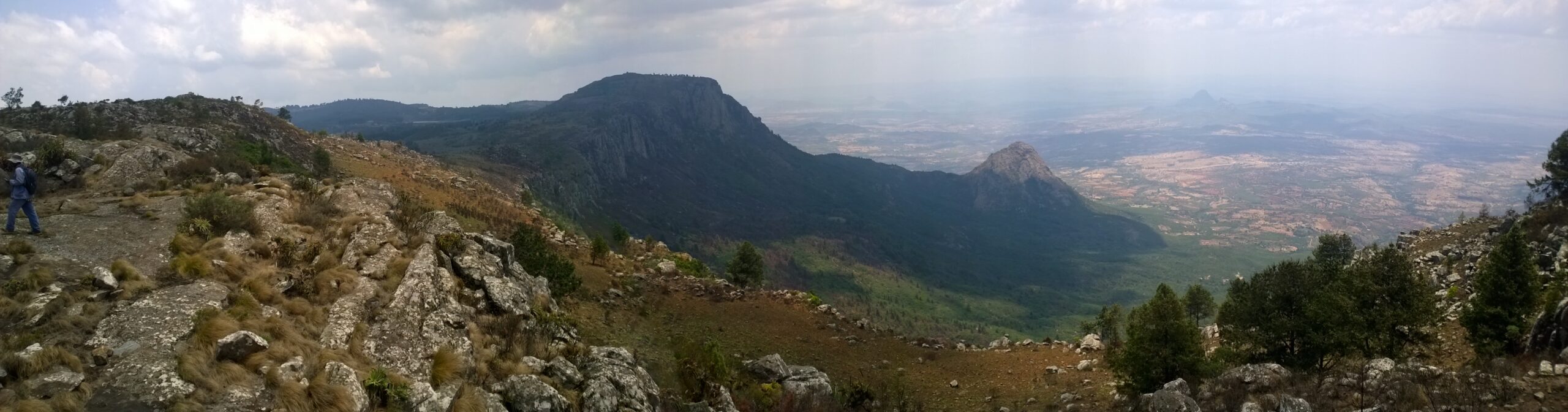
We take this opportunity to thank our many visitors, domestic and international, who have given their support and many kind comments on the most recent improvements to our beautiful view site.  Without their contributions, received via entrance fees and donations, we would certainly not be able to continue our development and maintenance of this very special and unique place.

The original little reception office built in the 1970s

           The Gallery as it stands today  

The Gallery has had a number of new extensions built over the last four years including two new display rooms and a toilet block to the rear.  Our latest addition is the covered veranda which was completed recently.

Work in progress…

  Foundations being laid                                                                               


New front door being made by local craftsmen

We formed an association with the National Gallery of Zimbabwe (Mutare branch) last year and have had several successful exhibitions to promote Zimbabwean artists. The NGZ continue to allow us to exhibit their artists’ works and as a result, many sales have been achieved on behalf of our young Zimbabwean artists.

Gill Honeyman (with Elizabeth Muusha,  Director of NGZ Mutare) taken  on a recent visit to the Mutare Gallery


Elizebeth Muusha with some of the works by artist Wilson Zuze – over 20 of his paintings were sold from the Gallery at World’s View               

 Some of the paintings that form part of our permanent collection: Nyanga Artists – Val Cameron, Edone Anne Logan, Cherrie Stead  and Gill Honeyman


The View has had a number of visits by delegations from various countries which have been hosted by the President’s Office, including The Marshall Islands and Equatorial Guinea. It is gratifying to know that World’s View is now on the agenda of our Government to showcase our natural heritage by bringing visiting heads of state to the Eastern Highlands.
The Hon. Oppah Muchingura, Minister of Defence and War Veterans’ Affairs signing the visitor’s bookon a recent visit to World’s View:

 “I just realised that Zimbabwe is such a beautiful country still to be discovered. With this visit I have the best impressions. Thanking the Trust for the zeal to maintain this place for future generations. Keep up the good work”.

Our battle continues with the illegal grazing of cattle on the escarpment; these pictures give evidence to the devastation caused by these beasts.

Inside the fenced area at the View                             


Outside of the fenced area! 

Illegal poachers with their hunting dogs are often seen in the area; this picture (left) was taken at the gates of World’s View over the Christmas holidays – the man in the foreground is carrying a sack of rock rabbits on his back!  The cattle in the background are part of a herd that are left to roam unattended and are forever being chased off the mountain by our caretakers, only for them to appear again a few days later.  All the game that used to wander the area has been completely poached out and even now it is rare to see a rabbit in your headlights when travelling the circular drive at night
Our third set of new gates has just been installed due to cattle damage, and fence repairs are an ongoing exercise.  The fence-line has been extended by 30 m to the south of the View.

Our appeal to Government to have the Connemara Basin put under protective management is almost ready for submission: our grateful thanks to Sharon Waterworth for preparing a brilliant covering document that outlines our aims and brings attention not only the problems of cattle and poaching but also the increasing necessity to preserve our montane grasslands, wetlands and indigenous species of flora and fauna.

We continue to make headway on the eradication of invasive species that have been taking over the area. Our wetlands are being threatened and the whole ecology of the area could be changed forever if steps are not taken to control the growth of pine, wattle and other invaders.  To date over 3000 pines have been removed from the escarpment by chainsaw, over 2000 by machete and countless numbers of saplings have been pulled by hand.   We would like to thank the board of Little Connemara for contributing towards this exercise and also some of the owners of the properties surrounding the Connemara Lakes for asking their own caretakers to help clear the areas opposite their properties.

The picnic areas are being put to good use and visitors enjoy the magnificent scenery and the gardens that have something of interest growing at all times of year.

The protea cuttings have now matured into strong sturdy plants and the ones grown from the Kirstenbosch seeds have been in flower and cuttings are being taken for propagating for our Plant Sales section.


We thank Mr Jim Dryburgh, a keen photographer and bird-watcher, for this selection of delightful photographs of proteacea and sunbirds taken on one of his visits to World’s View.

The World’s View Sculptors are producing many new pieces for sale in the Sculpture Garden. We are sorry to announce the death of their Chairman, Mr Xaviour Nyakete, who has been a great friend and contributor to the site. It is gratifying to know that his work has been sold to a number of international tourists and will grace many a home in far off lands.  Our condolences to his family and brother, Panganai, who has taken over the chairmanship of the Sculptors Committee.

The Gazebo and Sculpture Garden nestled at the foot of Nyamatoro (World’s View Mountain)

Our two caretakers at work in the gardens.


Arthur trimming edges                                                     


Luke tending to newlyp lanted hydrangeas at the entrance to the toposcope whom at (71) became the proud father of his 18th child in March!

Matirina and Arthur planting aloes on the slopes below the toposcope

Some of our smaller visitors


Before the Covid-19 lockdown we constructed a hands-free facility near the car park for visitors to wash their hands on arrival and departure. 


The Covid-19 outbreak, although we have not yet realised the true picture in Zimbabwe to date (April 2020), has already had a real impact on the number of visitors coming to the View. The lockdown has resulted in a 100% loss of income but it is gratifying to see that our people are taking full cognizance of the seriousness of the situation and staying at home!

We continue to keep the View site open albeit for maintenance and tending the garden with Luke on lockdown at home and Arthur, Matirina and myself doing what we can – at a respectable distance and with frequent hand washing!  The projects that we had intended to undertake have been put on hold and the finances to undertake these will now be channelled towards paying our two caretakers’ wages for as long as we have the resources.

Our thoughts are with all Zimbabweans and all those in other countries throughout the world who are suffering the loss of loved ones during this most awful time and look forward to the day when we can return to some normality and a brighter future.

Gill Honeyman

Chairman – World’s View Committee

Sunset – Mt Ziwa in the distance  


Tribute to Mike Kimberley

Tribute to Michael John Kimberley (2 May – 3 January 2020)

Eulogy for Michael John Kimberly by Hans Wolbert at the memorial service on 10 January 2020

Michael John Kimberly was born in Gweru on the 2nd of May 1934, his father worked on the postal service, his grandfather came to this country in 1895 with the pioneer column.  His childhood years were spent at Milton Junior School in Bulawayo.  The rest of his education was done in South Africa, where he passed his matric.

He graduated at Witwatersrand University in Arts and Law.  In 1960 he started practicing Law in Zimbabwe and continued working until his retirement in September 2013.  In 1961 he married Rose Lighton and had two sons Christopher and Richard, he was a hard working member of the History Society which he joined when he was in University.  He was one of the founding members of the Aloes Cactus and Succulent Society of Zimbabwe in 1969.  His acute knowledge in Law helped to legalise the Society.  He was not like normal gardeners in that he had a passion for the understanding and preservation of local succulents.  A lot of these plants are not really suited for the garden but his love for these plants truly made him a patriot of this country. Many of the existing laws in place to protect these plants owe their existence to Mike Kimberly.  His knowledge, in Plants and his social standing, brought in big names of the Succulent Plant World like Larry Leech, Darel Plowes, Alan Percy Lancaster, Susan Carter and many more.

His ambition and drive brought the society from strength to strength.  In 1975 he helped organise the First World Aloe Congress.  This was a huge undertaking and it put this country on the map.  In 1988 he organised the Aloe 88 Congress. He was the editor of 21 volumes of the internationally acclaimed Excelsa Journals plus four Taxanomic series of books.  The literature of these books passes well over the minds of the layman and there is serious doubt whether there will be any other volumes made without his drive and input.  He was also the editor of the Ingens bulletin the first of which was made in 1989.

I got to meet him and know him a little better about 11 years ago when I joined the Aloe Society.  I found him to be a very pleasant person full of witty comments which usually put a smile on my face.  He was very generous with his knowledge and always eager to further a person’s understanding in plants.  A few plants were named after him including an orchid where he was one of three Mikes mentioned in its name.  When we went on trips in the field he would walk around rather disappointed knowing that the soil in that particular area was not conducive to succulents but would liven up tremendously when he saw what he called “Sand Veld” in which we always found those unusual and interesting succulents dwelling there.  He had a very strong character and often tried to protect the Club personally which sometimes resulted in a few toes getting stood on.

In 2012 his beloved wife Rose passed away and I personally think that Mike started to slowly fade away from that time onwards.  His name will always be remembered at the Aloe Club, the world will remember his name in the Succulent World.  The world will be a lesser place without Mike, I wish him well with his journey, a journey which we will all have to start at some stage.

>>>>>>>>>>>>>>>>>>>>>>>>>>>>>>>>>>>>>>> 

Tribute from David Scott: Chairman, The National Trust of Zimbabwe and on behalf of the NTZ Council and members

I first met Mike in 1985 in his capacity as the Legal Counsel for the Zimbabwe Electricity Supply Authority. We worked extensively together on a project lasting approximately 12 months. Mike was an extremely determined, professional and thorough legal mind who was managing a very difficult project, in addition to his normal demanding position and amongst trying and extremely sensitive circumstances. That situation did not deter him from the project objectives and plan. It was a thorough learning experience from my perspective and an insight into the person he always was!! He introduced me then to Zimbabwe historical and cultural matters as he was heavily involved in the History Society of Zimbabwe, among other community and environmental areas.

Decades later, we met again when I was asked to join the Council of the NTZ where Mike had been on the Council for many many many years!! Mike took time out of his very busy schedule, then as a practising lawyer, to introduce me to the NTZ structure and its history. He kindly handed me documents giving a lot of background to NTZ.

Mike had an incredible memory recalling past matters that affected NTZ over decades. Mike was very supportive when I was elected as Chairman of the Council. We worked closely together on the NTZ Council, until he was no longer able to give of his time and then he suggested I visit him at home to discuss NTZ matters.

Mike was entirely selfless in his commitment to NTZ and all the honorary positions he held over many decades. I was very privileged to have met and worked with Mike, all be it only for a relatively short period of time.

RIP Mike, a dedicated community minded professional.

>>>>>>>>>>>>>>>>>>>>>>>>

Tribute by Robin Taylor, Chairman, History Society of Zimbabwe Mashonaland and on behalf of its Members

I am sorry to have to tell you that Michael (Mike) Kimberley passed away on Friday 3rd January. Mike Kimberley joined the then Rhodesiana Society in 1955 while still a student. He served as secretary of the Society for eleven years and in turn held the positions of Mashonaland Branch Chairman and National Chairman. In 1989 he became honorary editor of Heritage and held this position with great distinction and ability until 2013.

Mike was a wonderful and dedicated supporter of our Society and he made a great contribution to the success of the Society.

>>>>>>>>>>>>>>>>>>>>>>>>

Tribute by Edone-Anne Logan, The National Trust of Zimbabwe on behalf of Rhodes Nyanga Historical Exhibition and it’s Committee

Cecil John Rhodes, first came to the Nyanga area and fell in love with the rugged, isolated landscape.  He instructed MacDonald to purchase up to 100 000 acres (40 000 ha) of farmland. Later this became the Rhodes National Park.

The former homestead of G D Fotheringham on “Fruitfield” was selected by Rhodes as his residence (now Rhodes Hotel) and one of the first buildings he erected was a substantial stone barn and stable.

In 1970 a member of the Executive Committee of the National Trust of Rhodesia, and the Director of the National Archives, visited the barn and stable with a view to leasing it from the owners and preserving the historic site and artefacts.

The process was difficult and involved officials in many ministries.   The NTZ was determined however, and eventually, with the persistence of Mike Kimberley and others a lease was signed with National Parks and permission granted to open the renovated buildings to the public.  The Trust in the meantime had begun to collect articles of historic value, and the Archives made copies  – free of charge – of many historic pictures and documents.  This was the birth of the Rhodes Museum, now the Rhodes Nyanga Historical Exhibition – the only museum to be under the jurisdiction of the National Trust of Zimbabwe and the only museum of its kind in the country.

>>>>>>>>>>>>>>>>>>>>>>>>>>>>>

Tribute from close friends Ray and Sybil

Thank you for inviting us to contribute something towards Mike’s past contribution to the NTZ.

What comes to mind is that, in the early eighties, Mike phoned me in Bulawayo enquiring if I knew any of the manufacturers/suppliers of Bathroom suites in Matabeleland. As it happened I personally knew of a manufacturer of Bathroom Suites in Bulawayo and that I could assist.  I ordered the new bathroom hand basins and toilets for La Rochelle, Penhalonga, who were building 9 cottage type units on the Courtauld’s NTZ property for guests. I was able to arrange for an empty vehicle travelling to Harare to collect spares and supplies for Bulawayo Power Station, which I was responsible for,  to collect and deliver the sanitary ware to Harare, where Mike arranged for an empty vehicle travelling to  Mutare, to collect the items from Mutare and drop off the consignment at La Rochelle, thereby saving the NTZ the transport costs.

The other snippet is, when we saw the film ’Legal Eagle’ and then the ’Horse Whisperer’ with Robert Redford, the likeness was so uncanny that Sybil and I bought the DVD of the Horse Whisperer and took it to Harare and presented it to Rose and Mike, and started to call Mike, Robert. He was always referred to as Robert by us in Bulawayo, which he said he felt chuffed to be compared with the famous Film actor and Director.

It was the Kimberley’s, in the early eighties, that recruited us to become members of the NTZ, which influenced us to assist the NTZ wherever we could, which continues to date.

>>>>>>>>>>>>>>>>>>>>>>>>>>>>>>

Lin Goncalves – Executive Council Member, The National Trust of Zimbabwe

I first met Mike Kimberley about 15 years ago, in his lawyer’s offices in Throgmorton House having written to him to find out more about the Trust and La Rochelle as I had close family memories of the Courtaulds through my parents and the area.

His dedication and interest were so effective and enthusiastic that I was invited to join the Committee and attended the very next meeting. Mike’s knowledge of the local flora, orchids and aloes/succulents in particular, remained my inspiration.

In Mike’s passing we have lost a great character, and highly knowledgeable authority on his passion of indigenous orchids and aloes.

  >>>>>>>>>>>>>>>>>>>>>>>>>>>>>> 

Rob Burrett – Friend and work colleague – Some memories

It is with great sadness that I have heard of the passing of Mike Kimberley, one of the pillars of many voluntary organisations which have brought delight to many over the years. Mike was a man of diverse interests, dedicated to history and botany, his aloes in particular. He was always much more than an amateur, he was an expert in his own right. Criss-crossing the country in search of interesting plants, Mike and his late wife, Rose, would often go out to recover plants from areas that were to be developed, many of these found haven in his Mount Pleasant property.

I was privileged to know Mike in three of his many roles – the Aloe and Succulent Society; Rhodesiana, now the History Society of Zimbabwe; and the National Trust of Zimbabwe. It was in 1978 that I first met Mike. As a young school boy I was captivated by his historical interests and remember fondly the Rhodesiana Society historical steam-train run from Salisbury [now Harare] to Marandellas [Marondera]. If I recall the Kimberleys wore historical dress. Much later we met again, Mike and/or Rose editing the annual magazine of the History Society – Heritage of Zimbabwe. Under his guidance I was encouraged to write up my many and varied interests in the historical quirks of our country. Mike was always concerned that things should be recorded for prosperity in a published form. He would say that we all lose so much as people die or leave. In this way too, the family was actively involved in Excelsia, the Aloe Society journal. As I write I recall dropping by their home to leave my latest historical manuscript or some plant which I had recovered. We would sit on the veranda chatting about history and plants. My appreciation of aloes probably dates from those times and I am currently surrounded by aloes in my Bulawayo garden. One thing I still look out for is the rumoured WHITE Aloe excelsia from the Lowveld that Mike would often mention, hoping that in my fieldwork I would come across a specimen. Nothing yet Mike, sorry.

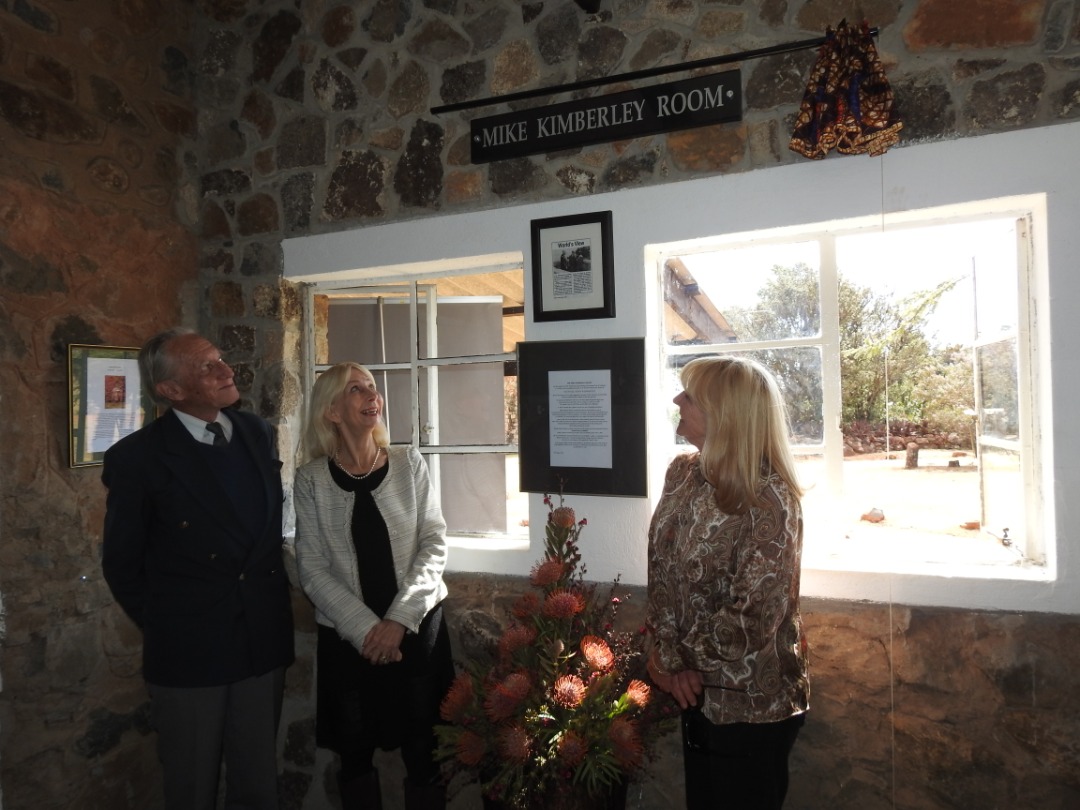
In the 1990s I was encouraged to join the NTZ by the late Helen Hyslop, another pillar of our Trust. It was at that time I got to know Mike in a somewhat different role in his efforts to safeguard the vulnerable properties held for all of us in the nation by the Trust. We did not always see eye-to-eye on matters, but all credit to Mike Kimberly and his committee for safeguarding what we have today. It is my sincere hope that the NTZ will see fit to commemorate Mike and Rose Kimberley in some permanent way.

I am sure there are many other sides to Mike and Rose Kimberley that I have not mentioned. I can, but only apologise. Mike and Rose had diverse interests and moved in several different circles. I can only give a personal reflection of where we came together. Zimbabwe, and the many societies which they founded and worked for over many decades, are all the poorer for the passing of this wonderful couple.

Rest in peace Mike and Rose.


RE: INVITATION TO HISTORY SOCIETY LUNCHEON; 13th October 2019

HISTORY SOCIETY OF ZIMBABWE

Founded 1953

RE: INVITATION TO HISTORY SOCIETY LUNCHEON; 13th October 2019

National Trust members are kindly invited to attend the HSZ Annual Luncheon, and for your support at any future.

Our speaker will be Dave Grant, the deputy head of Falcon College, an excellent speaker and fine historian.

I am, of course, fully aware of the current shortage of Zim dollars and the declining income of us all. We do need, however, to maintain the vibrancy, interest and fellowship of the Society, and it is important to keep-up events such as the one planned

Whilst I was hopeful of reflecting the cost of the luncheon in Zimbabwe dollars, with the recent escalation of rates and the likelihood of this continuing, this is no longer possible. The cost will therefore now be the ZW$ equivalent of US$ 23,00 at the RBZ rate of the day. This rate can easily be gleaned by accessing the website “market watch” alternatively you can contact me on my cell on 0772 265 884.

To give you some idea, the date on which I write this letter, 19th September,  the rate is 14.12 so the cost if paid today would be ZW$324,76.

I am sorry to complicate the matter but I know that you know we are all trying as best as we can to deal with the extraordinary challenges this country throws at us!

I do hope that many of you will be able to attend the luncheon, details of which are as follows:

Date:                               Sunday, 13th October, 2019

Time:                                 12 o’clock noon for 12.30pm

Venue:                           Cresta Lodge, Mutare Road, Harare

Cost:                             The ZW$ equivalent of US$ 23,00 per person    

Payable to:                     CABS, Account name: History Society of Zimbabwe

Account number: 1003139523

Booking deadline:           4th October, 2019

Booking and responses to: tim@ttc.co.zw

There will be a cash bar available.

When payment is effected, would you please also give your name. When you notify me of your booking please indicate the number and names of others in your party.

I very much look forward to hearing from you and am sure we shall have a  very enjoyable and sociable luncheon on the 13th October.

Please kindly reply directly to me. My email address is as follows: tim@ttc.co.zw. Thank you.

With kindest regards

Tim Tanser

(National Chairman, History Society of Zimbabwe)

Best Regards

Charles Castelin

Membership and Communications Member

History Society of Zimbabwe, Mashonaland Branch


Tribute to Helen de Barsy Hyslop

A Tribute to a Wonderful Person – June 2019


Helen joined the NTZ in 1993 and became a member of the Executive Council in 2003. She was Chair of the Rhodesia Association of University Women (1970 -1980). One of her major local achievements, at that time, with other groups was the lobbying for separate assessment for tax of female spouses in 1977. Helen was a regular member of International Federation of University Women s Council in Geneva promoting graduate women’s and feminist rights over that period. The University was established in 1919 and nearly 100 years later it continues to advocate for women’s rights, equality and empowerment through the access to quality secondary and tertiary education, and training up to the highest levels. The goal is for 100% of girls and women worldwide to achieve an education beyond primary school. Helen was an alumnus of University of Witwatersrand in South Africa.

Tribute from David Scott – Chairman of The National Trust of Zimbabwe
We shall miss Helen terribly but her memory will remain with the NTZ Councilors and particularly Shirley and I forever.
Helen was very passionate about The National Trust. She was an incredible source of knowledge and her logical/practical/worldly wise common sense positively influenced all our Council meetings and activities. Helen, with the support of her sons, selflessly helped develop NTZ over many decades through some very tough times.
Helen gave me, personally, tireless support and encouragement in my capacity as Chairman of NTZ, especially at the outset when I first joined NTZ. Helen always made sure we were doing the right thing at NTZ, when we ventured down a new path!! We spent many hours on the phone before and after Council meetings, discussing various matters and “chewing the cud” together. I was always confident that Helen would have some great advice and suggestions to any challenge we faced. I shall miss her wisdom and experience but will recall “what would Helen do” when dealing with issues into the future!
Helen was an amazing human being who committed herself to the wider community over her entire life, without thought for herself. Shirley and I thoroughly enjoyed our (all be it too short) time with Helen.
Rest in peace dear Helen.

Tribute from Sharon Waterworth – Deputy Chairperson The National Trust of Zimbabwe
May Helen rest in peace. I extend my deepest sympathies to Hel en’s family at this very sad time.
Helen volunteered and worked for the Trust for over 26 years during which time her contribution was significant and she was instrumental to its success. Helen was dedicated to the Trust and she also chaired the sub-committee for Heritage Houses which was another of her passions.
I had the very real privilege of working with Helen over the past decade or so. It was actually Helen that introduced me to the Trust and invited me to join the Executive Council, which I fortunately did. Helen is an inspirational lady whom will be deeply missed for her professional input and wisdom. Always an active member Helen helped to steer the Council in the right direction.
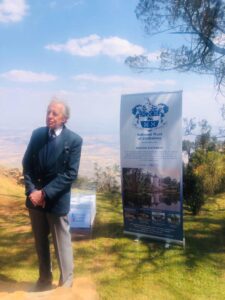
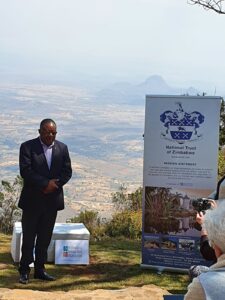
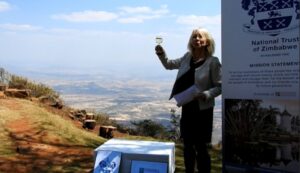
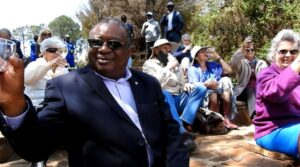
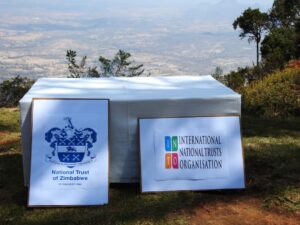
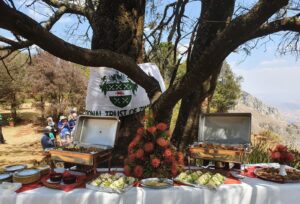
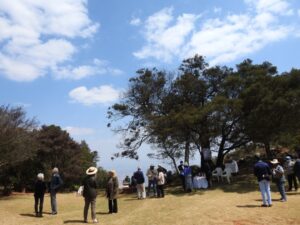
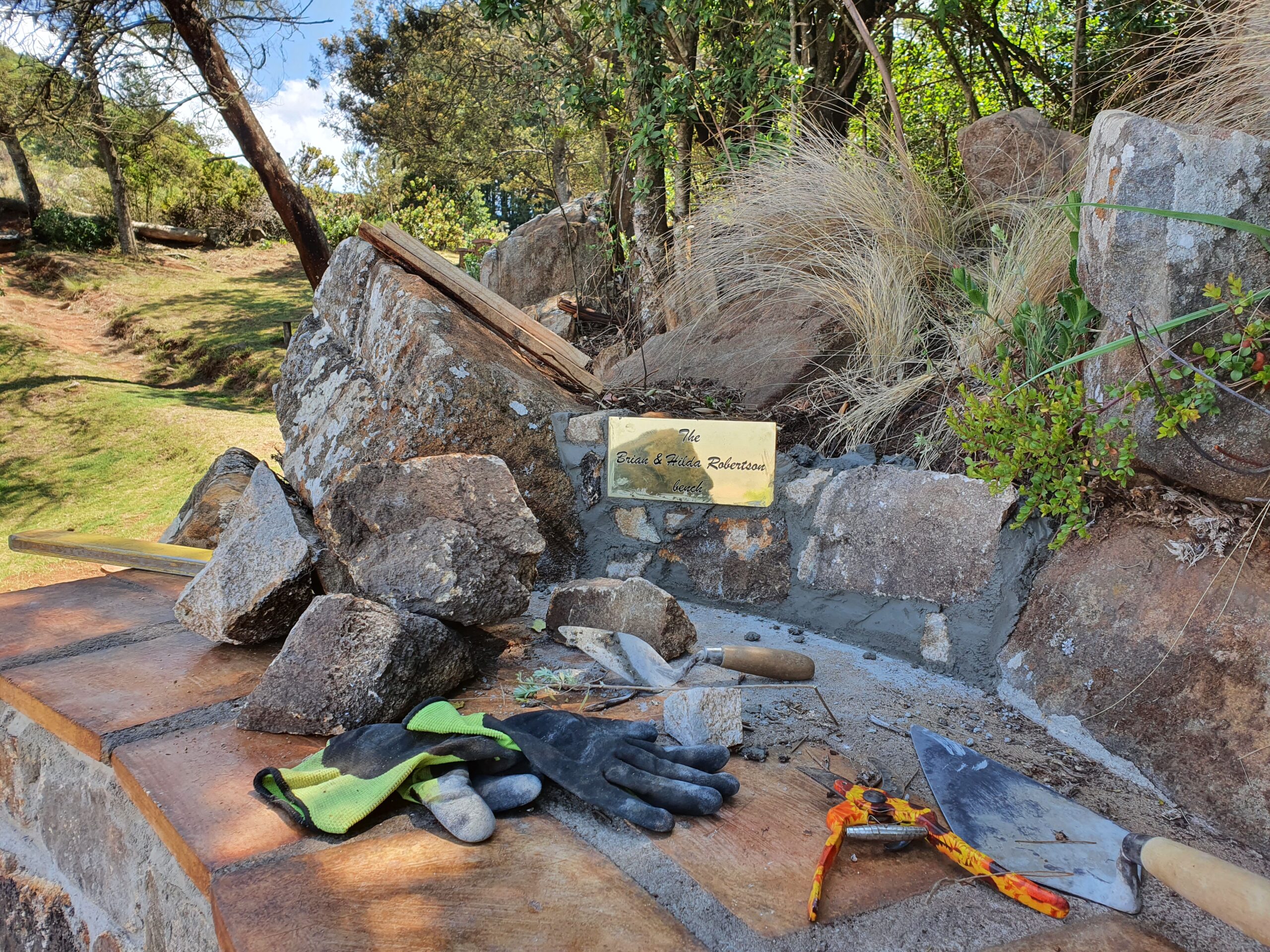
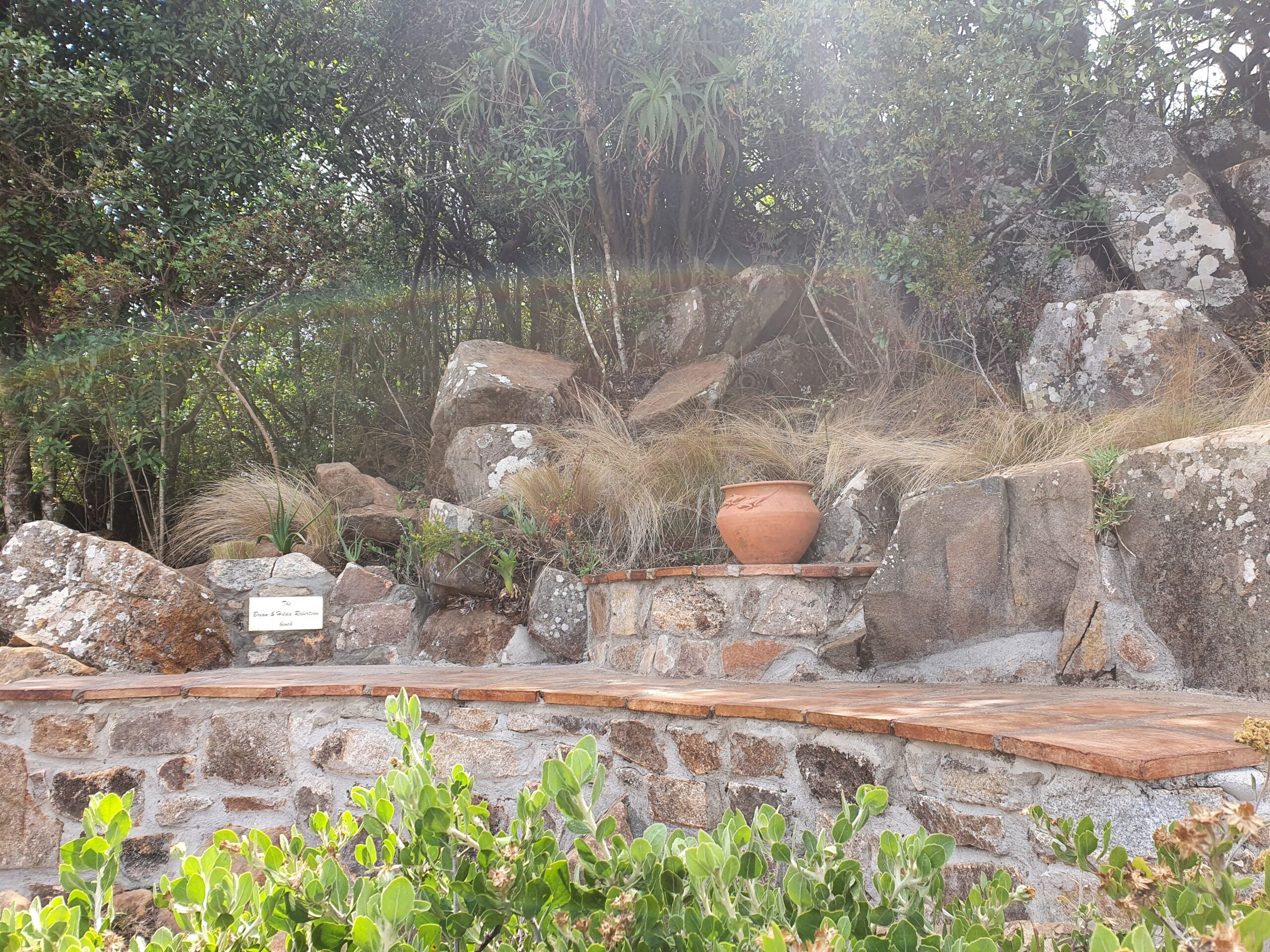
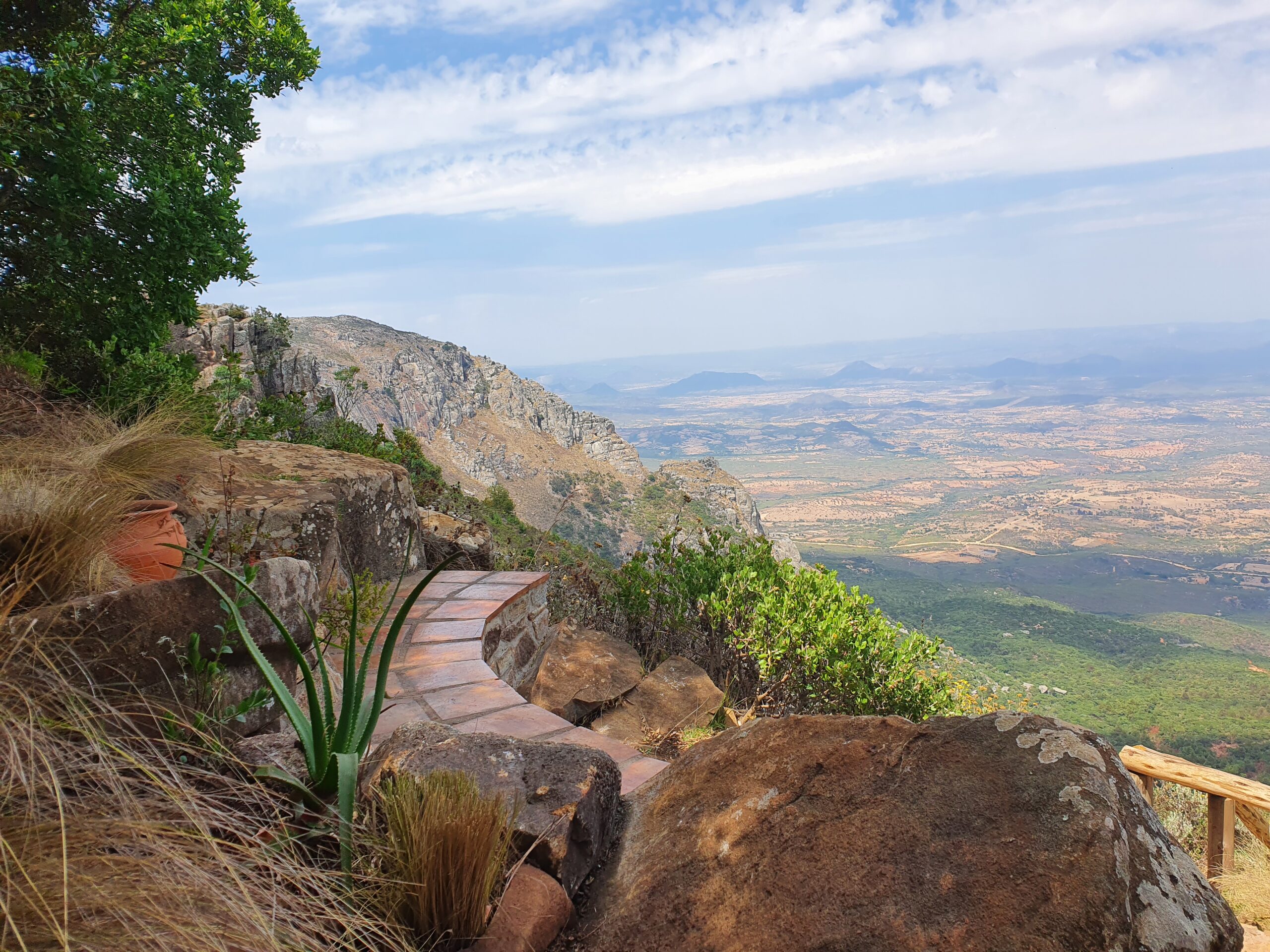
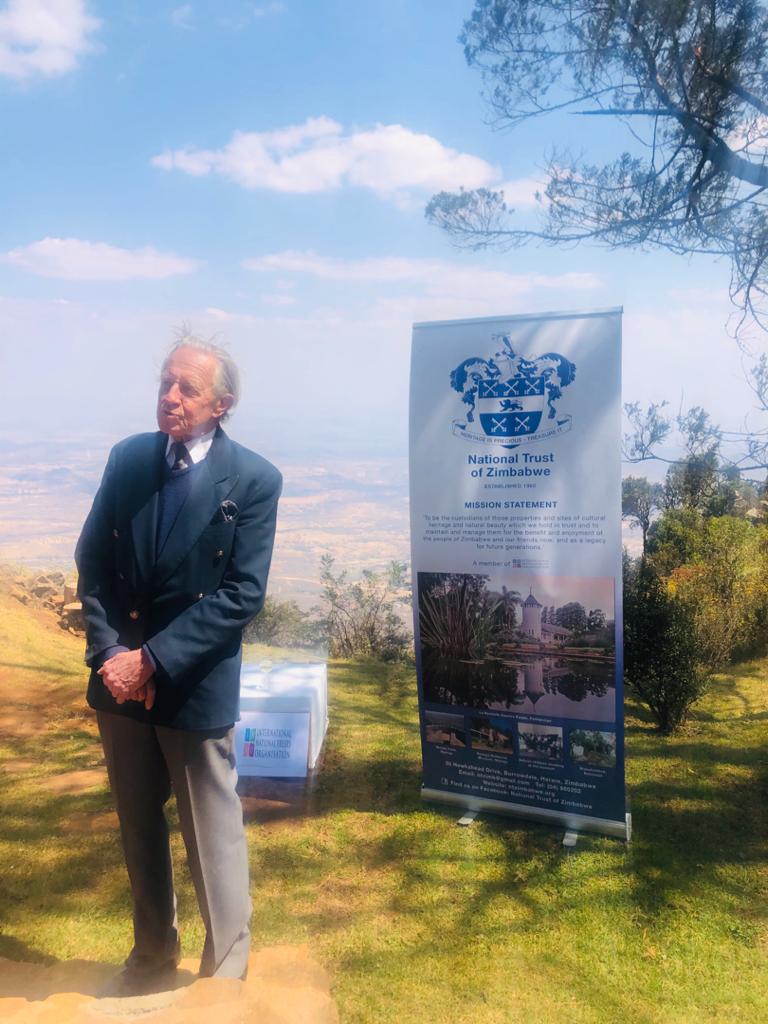
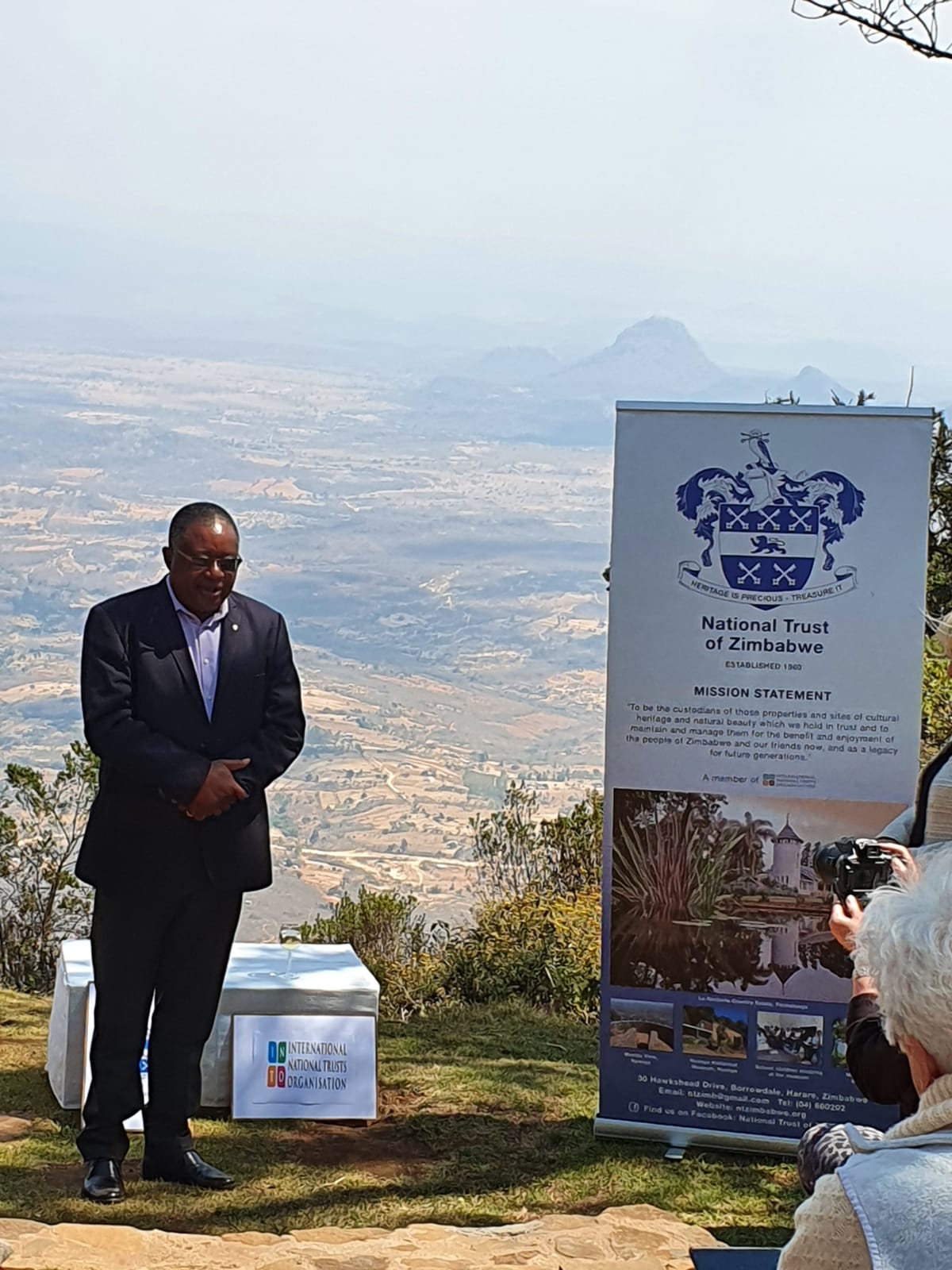
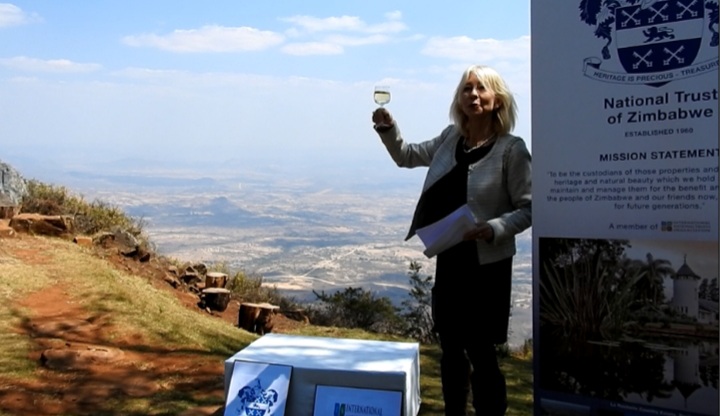
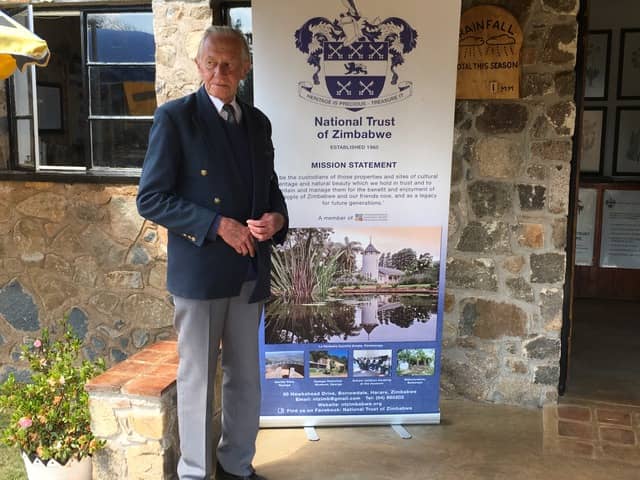
Upon reflection it was so fitting that on World Heritage Day in 2018 that the Trust honored Helen’s enormous input to the Trust and in recognition by unveiling a plaque at Worlds view (a Trust property) in Nganya close to where Helen enjoyed many family holidays. I attended the celebratory event along with other NTZ Councilors which took place on a kopje (hill) at an altitude of over 2,000 metres, one of the highest points in Zimbabwe, where the escarpment drops 600 metres to the plain below. Fittingly, Helen’s plaque sits proudly above the clouds and birds flying.


As you can see the view from the plaque is one of peace and of extreme beauty and it seems endless. In addition to the plaque Helen was also given the honor of a Protea flower being named after her, both will be a constant reminder of a very special lady and of her contribution to the Trust.

Tribute from Edone-Ann Logan personally and on behalf of the Rhodes Nyanga Historical Exhibition and it’s Committee
The loss of Helen is a tragic loss to the National Trust of Zimbabwe, and in particular to the Rhodes Nyanga Historical Exhibition (Rhodes Museum). From the start of the ‘upgrade ’of the museum Helen gave the Committee encouragement, and with her practical common sense, advised on many matters. Her passion and vision for the work was infectious! We hope that her valuable knowledge and experience has not been lost as Helen was a good teacher throughout her life, imparting her knowledge freely to so many.
Helen was an absolute gentlewoman and an excellent example of the best of our older generation of women in Zimbabwe who developed the country in past years to its highest standards. She will be greatly missed by many but certainly not forgotten.
Our most sincere condolences to John and Charles, who have been tremendously supportive to their mother . May the Lord be with them in their loss.
Sincerely, All RNHE members and their families.

TRIBUTE FROM FIRA BACHE
I shall miss Helen terribly as she more or less took me under her wing when my husband and I joined the Trust. She was so knowledgeable and ready to share that knowledge with us all.
To me she was truly inspirational and I remember well the long chats on the phone when we discussed all things pertaining to the Trust and to life in general. Helen was an amazing woman with many attributes but most of all a very kind heart.
My deepest condolences to her family, she will be sorely missed.
Rest in peace dear Helen.

Tribute from Gill Honeyman and the World’s View Team
So many years of wise words, advice and support from a very fine lady.
Will always be remembered by us all at World’s View for her kindness and generosity through good times and hardships. We shall miss Helen so much and have been privileged to have had her friendship over the many years that she has given of her unstinting support for all our projects and future goals.
Much love to John and Charles at this sad time from Gill, Matirina, Luke and Arthur.